
 Silver Bullet Pest Control
How to Prevent Wasp Nests: A Season-by-Season Plan for NJ Homes
Tired of finding a new wasp nest under the deck railing every July? Wasps pick the same kinds of spots on the same kinds of houses year after year. The good news: the best time to stop a nest is in spring, when a single queen is just getting started. This guide covers how to prevent wasp nests around your home, what really works, what doesn't, and when to leave a nest to a pro.
4.9 stars on Google • NJ License 90568B • 15+ years • Based in Garfield • Hablamos español
Found a nest? Text a photo to 973-510-2585 and we'll tell you what it is and how urgent it is.
- ✓ Same-day appointments often available
- ✓ Licensed & insured in NJ
- ✓ Homes & businesses
- ✓ English & Español
How do you prevent wasp nests?
To prevent wasp nests, check your eaves, deck, shed and play set every week or two from April through June and knock down small starter nests before they grow, close up holes and gaps in siding, soffits and vents before spring, keep trash cans and recycling sealed, and limit sweet food and drinks outdoors. In late summer, check the ground for yellow jacket holes. Once a nest is bigger than a golf ball or is in a wall, a lawn or up high, leave it to a professional. Call or text 973-510-2585.
Rodent Proofing & Exclusion – Quoted Separately
Rodent-proofing and exclusion services are quoted separately from pest control treatments and protection plans. Every property has unique entry points, structural conditions, and sealing requirements. Every home is built differently, so we use the materials each one needs, such as steel mesh, hardware cloth, sheet metal, concrete and sealant, on an as-needed basis. Following an inspection, we provide a customized estimate based on the specific work needed to help prevent rodents from entering your property.
When wasps start building nests in New Jersey
Every paper wasp, yellow jacket and hornet nest you see in August started with one queen in spring. Only the young queens survive the North Jersey winter, tucked into wall voids, attics, woodpiles, leaf litter and loose bark. When the weather warms up, usually in April and May, each queen comes out, finds a sheltered spot and builds a tiny starter nest, often only the size of a walnut, with a few cells.
For the first few weeks she does everything herself. Once the first workers hatch, the nest grows fast through June and July, and yellow jacket and hornet nests can hold hundreds or even thousands of wasps by late summer. That's when they're most defensive and most likely to sting, especially around food. The first hard frosts of fall kill the colony, and the nest isn't reused the next year.
The lesson: prevention is mostly a spring job. A five-second knockdown of a starter nest in May saves you a dangerous removal in August. Curious where they go in winter? See where yellow jackets go in winter.
Where wasps build nests on North Jersey homes
Eaves, soffits and gutters
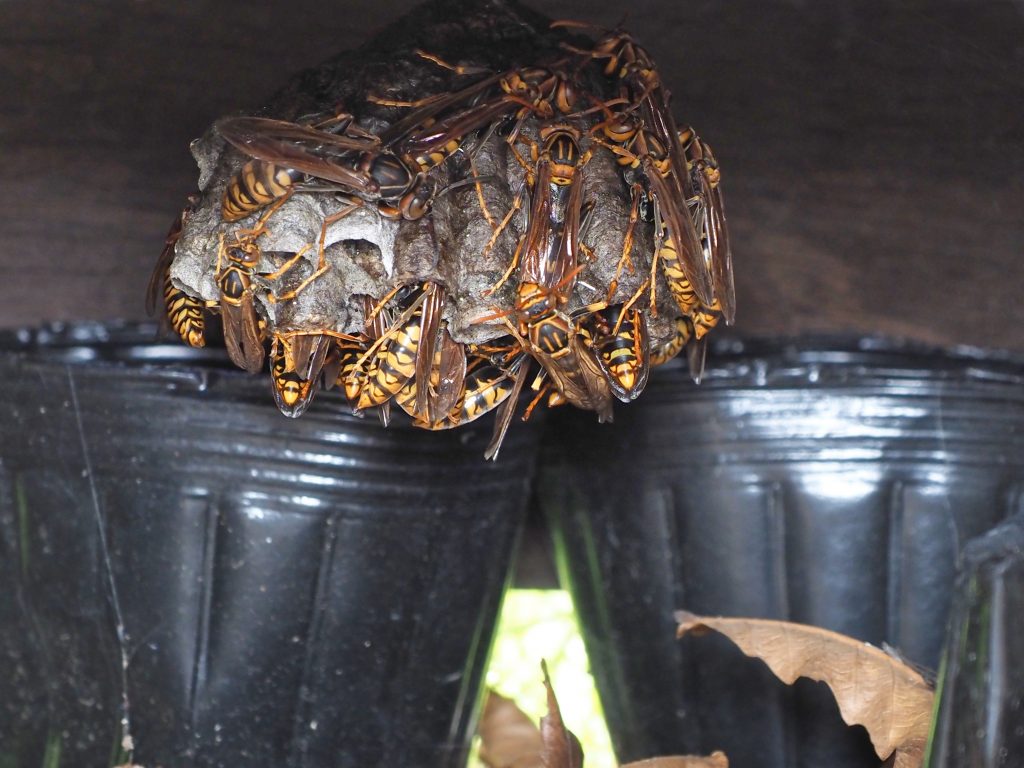
The underside of the roof overhang is the top spot for paper wasps. Gaps in soffits and behind gutters let yellow jackets build inside.
Decks, railings and porches
The underside of deck boards, railings, stair stringers and porch ceilings stay dry and shaded.
Wall voids and vents
Holes in siding, gaps around pipes and dryer or attic vents let yellow jackets build big hidden nests inside the walls.
In the ground
Yellow jackets often use old rodent burrows in lawns, under shrubs, along walkways and around tree roots.
Other favorites: shed and garage door frames, grills and grill covers, play sets, mailboxes, light fixtures, shutters, outdoor furniture and hedges. Bald-faced hornets often hang big gray nests in trees and shrubs.
Know which wasp you're dealing with
Prevention depends a little on the wasp, because each one prefers different spots:
| Wasp | Nest | Where in NJ yards | Temperament |
|---|---|---|---|
| Paper wasp | Open, umbrella-shaped comb, cells visible | Eaves, deck rails, door frames, grills | Fairly calm unless the nest is disturbed |
| Yellow jacket | Enclosed paper nest, often hidden | In the ground, wall voids, attics, sheds | Aggressive near the nest and around food in late summer |
| Bald-faced hornet | Large gray football-shaped paper nest | Trees, shrubs, high on eaves | Very defensive of the nest |
| Mud dauber | Tubes of mud | Garages, sheds, under eaves | Rarely stings; solitary |
| European hornet | Brown paper nest in a cavity | Hollow trees, wall voids, attics; active at night near lights | Defensive near the nest |
Not sure which one you have? Our wasp, hornet and yellow jacket ID guide and are yellow jackets bees or wasps? will help.
How to keep wasps from building nests: 8 steps that work
Inspect every week or two in spring
From April through June, walk around the house and look up under eaves, deck rails, porch ceilings, the shed and play set. Starter nests are small, gray and easy to miss.
Knock down starter nests early
A walnut-sized nest with one queen can be knocked down with a long broom or a stream from the hose, ideally in the early morning or evening when the queen is calmer. Only do this if you're not allergic, and walk away if more than a few wasps show up.
Close up holes before spring
In late winter, before queens are out, fill or cover gaps in siding, soffits, around pipes and wires, and fix torn vent screens. Never close a hole that wasps are using right now; they'll chew a new way out, sometimes into the house.
Seal trash and recycling
Tight lids on garbage and recycling, and rinsed cans and bottles, take away the sugar and protein that draw yellow jackets in late summer.
Watch food and drinks outdoors
Cover food and drinks at barbecues, clean up spills, and don't leave pet food outside. Check soda cans before drinking from them.
Manage fruit trees and feeders
Pick up fallen fruit, and keep hummingbird feeders clean and away from doors and patios.
Fill old burrows in the lawn
Old rodent holes and soft spots in the lawn are yellow jacket starter sites. Fill them in early spring, before any wasps are using them.
Paint or seal bare wood
Paper wasps chew weathered, unpainted wood to make their paper. Painted or sealed wood on fences, sheds and decks is less inviting.
Want to understand the ground nests better? See do yellow jackets nest in the ground?
Wasp prevention calendar for New Jersey
| Season | What wasps are doing | What you should do |
|---|---|---|
| Winter (Dec–Mar) | Queens hibernate in protected spots; old nests are empty | Fix holes in siding and soffits, repair vent screens, plan to paint bare wood |
| Spring (Apr–May) | Queens start small starter nests | Inspect every 1–2 weeks, knock down starter nests, fill lawn holes |
| Early summer (Jun–Jul) | First workers hatch; nests grow fast | Keep checking; call a pro for nests larger than a golf ball or in walls |
| Late summer (Aug–Sep) | Peak colony size; yellow jackets hunt sugar | Cover food, seal trash, watch for ground nests when mowing |
| Fall (Oct–Nov) | Colonies die off after frosts; new queens look for shelter | Remove old nests once they're empty, clean gutters |
Timing varies with the weather: a warm spring starts the season earlier, and a mild fall keeps yellow jackets going longer.
Wasp prevention tips that don't work as well as you'd think
- Fake nests (decoys). The idea is that wasps avoid building near another colony. Some homeowners swear by them, but results are mixed, and they won't do anything for yellow jackets nesting in the ground or inside walls. Fine to try, not something to rely on.
- Peppermint oil and essential oil sprays. They may keep a few wasps away from a spot for a short time, but they wear off fast outdoors and won't stop a queen from nesting nearby.
- Wasp traps. Store-bought traps catch some yellow jackets in late summer, but they don't touch the nest and can draw more wasps into your yard. If you use them, hang them away from where people sit.
- Spraying the house with insecticide in spring. A random exterior spray won't stop nest building and can harm bees and other helpful insects. Inspecting and removing starter nests works better.
- Plugging the hole of an active nest. This is a common and dangerous mistake. Trapped yellow jackets chew through drywall and ceilings and come into the house.
Wondering whether store sprays are enough for an existing nest? Read wasp spray vs. professional removal.
Keep wasps away without harming the bees
Not every buzzing insect around your house is a wasp. Honey bees and bumble bees are important pollinators and much calmer than yellow jackets. If you find a honey bee swarm or colony, don't spray it. We work with a local beekeeper so honey bee swarms and colonies are relocated, not exterminated. See New Jersey beekeepers for more.
Big black-and-yellow bees drilling perfectly round holes in fascia boards, railings or eaves are carpenter bees, which nest in wood instead of building paper nests. We offer carpenter bee treatment; see carpenter bee control and carpenter bee vs. bumble bee.
When a wasp nest needs a professional
Prevention handles starter nests. Call a professional instead of trying it yourself when:
- The nest is bigger than a golf ball, or you can see a lot of wasps coming and going.
- It's a yellow jacket nest in the ground, in a wall, attic, shed wall or behind siding.
- It's a bald-faced hornet nest, or it's up high and needs a ladder.
- Anyone in the house is allergic to stings, or the nest is near a door, a play area or a pool.
- Wasps are getting inside the house.
Silver Bullet Pest Control removes wasp, hornet and yellow jacket nests across Bergen, Passaic, Essex and Hudson counties, and same-day appointments are often available. We're based in Garfield and hold NJ License 90568B. See our bee and wasp removal page or, if someone's being stung right now, emergency wasp and hornet removal.
Get a free wasp quote
Already have a nest? Tell us where it is and send a photo if you can do it safely. We'll tell you how soon it should come down.
Why homeowners call us for wasps
- We identify the wasp before treating
- Ground, wall and high nests handled safely
- Honey bees relocated with a local beekeeper
- Same-day appointments are often available
- 4.9 stars on Google, hablamos español
Request Service
🔒 Your info stays private · Hablamos español.
Wasp prevention questions
What is the best way to prevent wasp nests?
The best way is to inspect your eaves, deck, shed and play set every week or two in spring and knock down starter nests while they're still small. Combine that with sealing holes in siding before spring and keeping trash and outdoor food covered.
When do wasps start building nests in NJ?
In North Jersey, queens usually start nests in April and May as the weather warms. Nests grow quickly through June and July and peak in late summer, so spring is the time to stop them.
What keeps wasps away from my house?
Nothing keeps every wasp away, but you can make your house less attractive: closed gaps and vents, sealed trash, no sweet drinks or fallen fruit left out, painted wood, and regular checks for starter nests in spring.
Do fake wasp nests work?
Results are mixed. Some paper wasps may avoid building right next to a decoy, but decoys do nothing for yellow jackets in the ground or inside walls. They're fine as an extra, not as your main plan.
Will wasps come back to the same nest next year?
No. A paper wasp, yellow jacket or hornet nest is used for one season only. But new queens often pick the same kinds of spots on the same house, so check those areas again in spring.
Is it safe to knock down a wasp nest myself?
A tiny starter nest in spring with one queen can usually be knocked down safely if you're not allergic. Larger nests, yellow jacket nests in the ground or walls, and hornet nests are much riskier and should be left to a professional.
Should I seal the hole yellow jackets are using?
No, not while they're active. Trapped yellow jackets will chew a new way out, sometimes through drywall into your home. Have the nest treated first and close the hole later, once the nest is dead.
Does spraying the house prevent wasps?
A general exterior spray isn't a reliable way to prevent nests and can harm bees. Inspecting in spring and removing starter nests works better. For active nests, professional treatment targets the nest itself.
What should I do about honey bees near my house?
Don't spray them. Honey bees are pollinators, and we work with a local beekeeper so swarms and colonies are relocated, not exterminated. Call us and we'll tell you if what you're seeing is honey bees or wasps.
¿Cómo evito que las avispas hagan nidos en mi casa?
Revise los aleros, la terraza y el cobertizo cada una o dos semanas en primavera y quite los nidos pequeños, selle huecos antes de la primavera y tape la basura. Para nidos grandes, llame o mande texto al 973-510-2585, hablamos español.
Is rodent proofing included in the price?
Rodent-proofing and exclusion services are quoted separately from pest control treatments and protection plans. Every property has unique entry points, structural conditions, and sealing requirements. Every home is built differently, so we use the materials each one needs, such as steel mesh, hardware cloth, sheet metal, concrete and sealant, on an as-needed basis. Following an inspection, we provide a customized estimate based on the specific work needed to help prevent rodents from entering your property.
Wasp and hornet help near you
We remove wasp, hornet and yellow jacket nests in these towns and across North Jersey.
Our service area
Bergen County
973-510-2585- Allendale
- Bergenfield
- Bogota
- Carlstadt
- Cliffside Park
- Closter
- Cresskill
- Demarest
- Dumont
- East Rutherford
- Edgewater
- Elmwood Park
- Emerson
- Englewood
- Englewood Cliffs
- Fair Lawn
- Fairview
- Fort Lee
- Franklin Lakes
- Garfield
- Glen Rock
- Hackensack
- Harrington Park
- Hasbrouck Heights
- Haworth
- Hillsdale
- Ho-Ho-Kus
- Leonia
- Little Ferry
- Lodi
- Lyndhurst
- Mahwah
- Maywood
- Midland Park
- Montvale
- Moonachie
- New Milford
- North Arlington
- Northvale
- Norwood
- Oakland
- Old Tappan
- Oradell
- Palisades Park
- Paramus
- Park Ridge
- Ramsey
- Ridgefield
- Ridgefield Park
- Ridgewood
- River Edge
- River Vale
- Rochelle Park
- Rutherford
- Saddle Brook
- Saddle River
- South Hackensack
- Teaneck
- Tenafly
- Teterboro
- Upper Saddle River
- Waldwick
- Wallington
- Washington Township
- Westwood
- Woodcliff Lake
- Wood-Ridge
- Wyckoff
Passaic County
973-510-2585- Bloomingdale
- Clifton
- Haledon
- Hawthorne
- Little Falls
- North Haledon
- Passaic
- Paterson
- Pompton Lakes
- Prospect Park
- Ringwood
- Totowa
- Wanaque
- Wayne
- West Milford
- Woodland Park
Essex County
973-510-2585- Belleville
- Bloomfield
- Caldwell
- Cedar Grove
- East Orange
- Essex Fells
- Fairfield
- Glen Ridge
- Irvington
- Livingston
- Maplewood
- Millburn
- Montclair
- Newark
- North Caldwell
- Nutley
- Orange
- Roseland
- Short Hills
- South Orange
- Verona
- West Caldwell
- West Orange
Hudson County
973-510-2585Union County
973-510-2585- Berkeley Heights
- Clark
- Cranford
- Elizabeth
- Fanwood
- Garwood
- Hillside
- Kenilworth
- Linden
- Mountainside
- New Providence
- Plainfield
- Rahway
- Roselle
- Roselle Park
- Scotch Plains
- Springfield
- Summit
- Union
- Westfield
Morris County
973-510-2585- Boonton
- Butler
- Cedar Knolls
- Chatham
- Denville
- Dover
- East Hanover
- Florham Park
- Hanover
- Kinnelon
- Lincoln Park
- Madison
- Mendham
- Montville
- Morris Plains
- Morristown
- Mountain Lakes
- Parsippany
- Pequannock
- Randolph
- Riverdale
- Rockaway
- Roxbury
- Whippany
Updated November 2026 by the Silver Bullet Pest Control team, Garfield, NJ • NJ License 90568B