
 Silver Bullet Pest Control
Honey Bee Removal & Extraction Services in New Jersey in Harrison, NJ
A buzzing ball of bees on the fence, bees flying in and out of a gap in the siding, or a swarm hanging from a tree in the yard? If they're honey bees, they shouldn't be exterminated. Silver Bullet Pest Control works with a local beekeeper so honey bee swarms and colonies are relocated alive, and we handle the wasps, hornets and yellow jackets that do need to go.
4.9 stars on Google • NJ License 90568B • 15+ years • Honey bees relocated, not killed • Hablamos español
Text a photo of the bees to 973-510-2585 from a safe distance. We'll tell you if they're honey bees.
- ✓ Same-day appointments often available
- ✓ Licensed & insured in NJ
- ✓ Homes & businesses
- ✓ English & Español
How does bee removal work in NJ when they're honey bees?
Bee removal in NJ for honey bees means relocation, not extermination: Silver Bullet Pest Control works with a local beekeeper who collects the swarm or colony and moves it to a hive. Text us a photo first, because wasps, hornets and yellow jackets look similar and are handled differently. We serve Bayonne, the rest of Hudson County, and Bergen, Passaic and Essex counties. NJ License 90568B. Call or text 973-510-2585.
Why we call a beekeeper for honey bees
Honey bees pollinate gardens, fruit trees and crops, and beekeepers value healthy colonies. Killing them when they can be moved makes no sense. That's why, when we confirm honey bees, we bring in a local beekeeper to relocate them.
There's a practical reason too. When an established honey bee colony is killed inside a wall or roof, the wax and honey stay behind. Without the bees to cool it, the comb can melt, honey can soak into walls and ceilings, and the leftovers attract other insects and rodents. Relocating the bees, and dealing with the comb, avoids those problems.
Wasps, hornets and yellow jackets are a different story. They aren't relocated, and nests near doors, decks and play areas are a real stinging risk. We remove those ourselves. See bee and wasp removal in New Jersey.
Honey bee, bumble bee or yellow jacket? How to tell
Most bee calls turn out to be one of these. Here's how to tell them apart from a safe distance:
| Look at | Honey bee | Bumble bee | Yellow jacket |
|---|---|---|---|
| Body | Fuzzy, golden-brown with darker bands | Big, round, very fuzzy, black and yellow | Smooth and shiny, bright yellow and black |
| Nest | Wax comb in a tree, wall, roof or a hanging swarm | Small nest in the ground, under sheds or in old insulation | Paper nest in the ground, in walls or under eaves |
| Behavior | Busy, steady flights in and out of one opening | Slow, bumbling flight around flowers | Fast, darting; hangs around food and trash |
| Stings | Once, near the colony | Rarely, if handled | Many times, defensive near the nest |
| What we do | Relocated with a beekeeper | Often left alone; ask us | Nest treated and removed |
Bees boring perfect round holes in wood trim or deck rails are carpenter bees. Ask us about those, since they're handled differently from honey bees.
Look-alikes we remove ourselves
If the photo shows one of these, it isn't a beekeeper job. We treat and remove the nest:
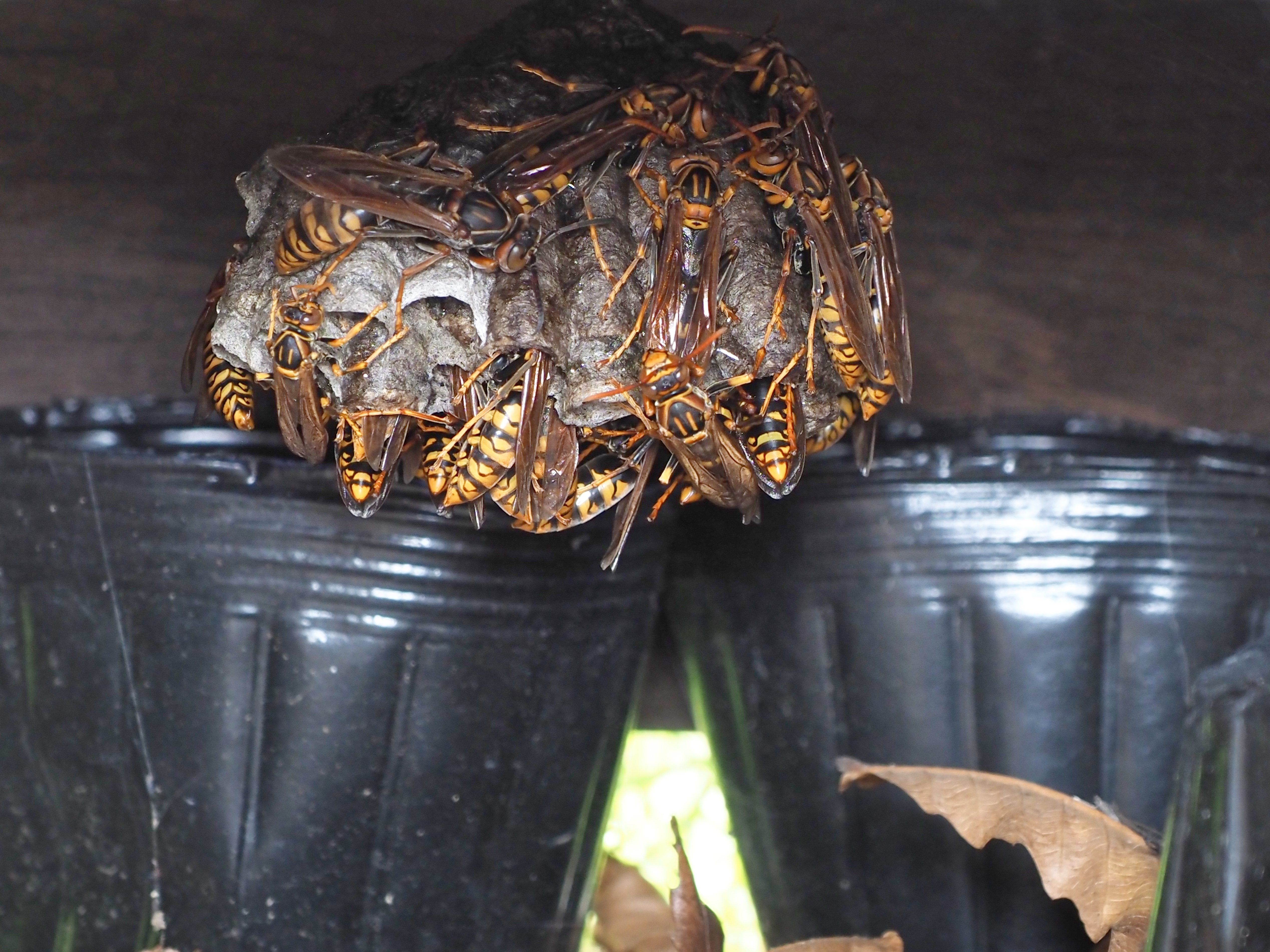
Paper wasps
- Slim body with long dangling legs
- Open, umbrella-shaped paper nest
- Under eaves, porch roofs and railings
Paper wasps are often called bees, but their nests are open paper combs with no wax or honey. They sting when the nest is disturbed, so nests near doors and porches should come down.
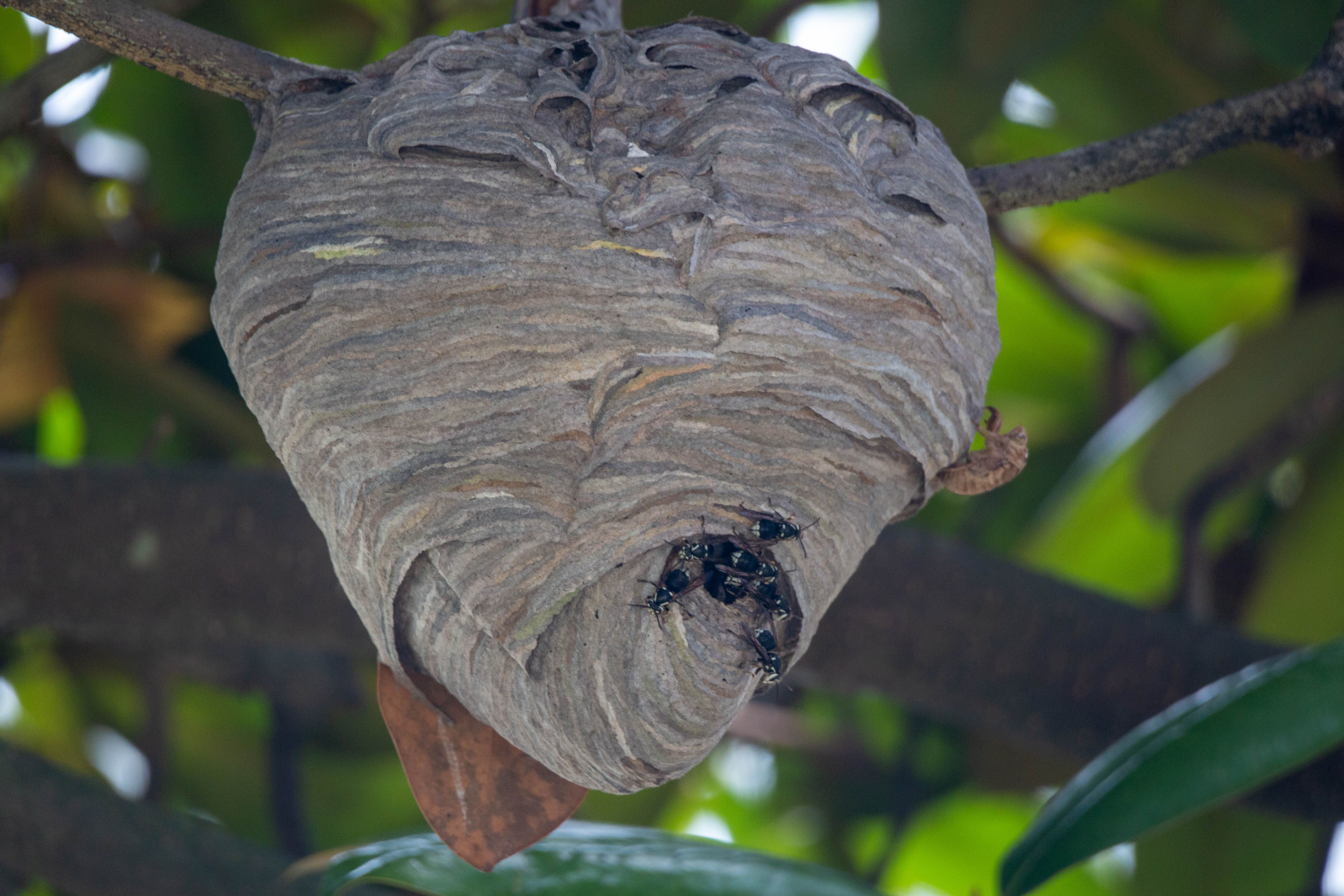
Bald-faced hornets
- Black and white, larger than a honey bee
- Gray paper ball nest in trees and shrubs
- Swarms out fast when the nest is bumped
These football-shaped nests are sometimes mistaken for a beehive. They're not, and they shouldn't be approached. A licensed technician treats and removes them with protective gear.

Can't tell what it is?
- Text a photo from a safe distance
- Note where they go in and out
- Keep kids and pets away
A lot of bee calls start with a photo. Once we know what it is, we can tell you if a beekeeper is needed or if it's a wasp nest we can remove, and give you a free quote.
Found a honey bee swarm? What to do right now
Stay back and stay calm
A swarm is bees looking for a new home. They're usually gentle because they have no hive to defend yet. Keep people and pets away anyway.
Don't spray or hose them
Spraying kills bees that a beekeeper could save, and it can make them defensive and scatter them into your walls.
Take a photo and note the spot
Is it a hanging cluster on a branch or fence, or bees going into a gap in the house? That changes how they're collected.
Call or text quickly
Swarms often move on within hours to a few days, sometimes into a wall or chimney. The sooner the beekeeper gets there, the easier it is.
Allergic to stings, or someone was stung and has trouble breathing or swelling of the face or throat? Call 911 first.
How bee removal with a beekeeper works
Here's what happens after you call:
We identify the insect
From your photo or on site, we confirm it's honey bees and not wasps or yellow jackets.
We look at where they are
A swarm on a branch or fence is the simplest. Bees living inside a wall, roof or chimney is a bigger job.
The beekeeper relocates them
Our beekeeper partner collects the bees and takes them to a hive, so the colony survives.
We help keep them out
Once the bees are gone, the opening they used should be closed so a new swarm doesn't move into the same spot next year.
For sealing gaps that bees and wasps keep using, see bee and wasp exclusion and sealing.
Honey bees living in a wall, roof or chimney
A swarm that sat on a tree for a day is easy. A colony that has lived inside a wall for months is not. By then the bees have built wax comb, raised young and stored honey in the space between the studs or under the roof.
- Signs of an established colony: a steady stream of bees going in and out of one gap all day, buzzing in a wall, or dark stains on the siding or ceiling.
- Why it matters: the comb and honey usually need to come out with the bees, or they cause the melting, staining and pest problems described above.
- What it takes: getting to the comb can mean opening part of a wall, soffit or ceiling. Every house is different, so ask us how it would be handled for yours before any work starts.
Don't seal the hole while bees are inside. Trapped bees look for another way out, and that can be into your living room.
Bee removal in Bayonne, Jersey City and Hudson County
Hudson County gets a lot of bee and wasp calls from older row houses, two- and three-family homes and apartment buildings. In Bayonne and Jersey City, the brick, cornices, porch roofs and fire escapes give bees and wasps plenty of protected places to settle.
- Cornices and porch roofs: common spots for paper wasps, and sometimes for honey bees moving into a gap.
- Gaps in brick and siding: where honey bees or yellow jackets can set up inside the wall.
- Small backyards: where swarms land on fences, trees and grills in late spring and early summer.
- Parks and the waterfront: open green space near homes means more flowers, more foraging bees and more swarms nearby.
We serve Bayonne and all of Hudson County from our base in Garfield. For wasps and hornets in Bayonne, see hornet and wasp service in Bayonne. We also cover bees and wasps in Hackensack and the rest of Bergen, Passaic and Essex counties.
What affects the cost of bee removal
Quotes are free. These are the things that change the size of the job:
| Factor | Simpler job | Bigger job |
|---|---|---|
| What it is | A fresh honey bee swarm in the open | An established colony inside the house |
| Location | Low branch, fence or bush | High roofline, chimney, inside a wall or ceiling |
| Comb | No comb yet | Months of comb and honey to remove |
| Access | Easy to reach from the ground | Ladders, lifts or opening part of the building |
| After | Nothing needed | Sealing the opening, repairs, cleanup |
Send a photo and tell us where the bees are. Call or text 973-510-2585 for a free quote.
Get a Free Quote for Bee Removal
Send a photo of the bees and tell us where they are. We'll tell you whether a beekeeper is needed and give you a free quote.
Why people call us about bees
- A swarm hanging on a tree or fence
- Bees going in and out of the siding
- Buzzing inside a wall or ceiling
- Not sure if it's bees, wasps or hornets
- Want the bees saved, not killed
Request Service
🔒 Your info stays private · Hablamos español.
Bee Removal and Beekeeper Questions
Will a beekeeper remove bees for free in NJ?
Some hobby beekeepers will collect an easy swarm hanging in the open for free, but colonies inside walls, roofs or chimneys take time, tools and sometimes repairs, so they usually cost money. Silver Bullet Pest Control works with a local beekeeper and gives you a free quote once we know where the bees are and how long they've been there.
Is it illegal to kill honey bees in New Jersey?
We don't give legal advice, but killing honey bees that can be relocated is a waste of a valuable pollinator, and it often causes more problems in the house from leftover comb and honey. That's why we work with a beekeeper to relocate honey bee swarms and colonies instead of exterminating them. Rules can change, so check with the state if you need a legal answer.
How long will a honey bee swarm stay?
A honey bee swarm usually stays from a few hours to a few days while scout bees look for a new home. Once they choose a spot, the whole cluster leaves at once. The risk is that they pick a gap in your house. Calling early gives the beekeeper the best chance to collect them while they're still in the open.
What should I do if bees are in my wall?
If bees are in your wall, don't spray them and don't seal the hole. Sealing traps them, and they may find a way into your living space. Take a photo of the opening from a safe distance and call or text us. We'll confirm whether they're honey bees and explain how the colony and comb would be removed.
How can I tell honey bees from yellow jackets?
Honey bees are fuzzy and golden-brown, and they fly steadily in and out of one opening. Yellow jackets are smooth, shiny and bright yellow and black, they dart around fast, and they hang around food and trash. Yellow jackets are far more defensive near the nest. If you're not sure, text us a photo.
Are honey bee swarms dangerous?
Honey bee swarms are usually gentle, because they have no hive, young or honey to defend yet. That doesn't mean you should get close. Keep kids and pets away, don't throw things or spray water at them, and call for removal. Anyone allergic to stings should stay well away and keep their medication nearby.
Do you remove wasp and hornet nests too?
Yes. We remove paper wasp, bald-faced hornet and yellow jacket nests ourselves, including nests in walls, under eaves and in the ground. These aren't relocated like honey bees. A licensed technician treats the nest with protective gear, removes it where it can be reached and checks the property for other nests.
When is bee swarm season in New Jersey?
Bee swarm season in New Jersey is mainly late spring and early summer, when strong colonies split and half the bees leave with the old queen to find a new home. Swarms can also happen later in summer. Wasp and yellow jacket nests, on the other hand, keep growing through the summer and are at their worst in late summer and fall.
Do you do bee removal in Bayonne?
Yes, we do bee removal in Bayonne and across Hudson County, including Jersey City, Kearny and the towns around them. Honey bees are relocated with our beekeeper partner, and wasp and hornet nests are removed by our technicians. Call or text 973-510-2585 with a photo, and we'll give you a free quote.
¿Ustedes quitan abejas en español?
Sí, hablamos español. Si tiene abejas de miel, las reubicamos con un apicultor local en vez de matarlas. Las avispas y los avispones los eliminamos nosotros. Mándenos una foto por texto al 973-510-2585, desde una distancia segura, y le damos una cotización gratis.
Bee removal in North Jersey
From our base in Garfield we cover Hudson, Bergen, Passaic and Essex counties.
Our service area
Bergen County
973-510-2585- Allendale
- Bergenfield
- Bogota
- Carlstadt
- Cliffside Park
- Closter
- Cresskill
- Demarest
- Dumont
- East Rutherford
- Edgewater
- Elmwood Park
- Emerson
- Englewood
- Englewood Cliffs
- Fair Lawn
- Fairview
- Fort Lee
- Franklin Lakes
- Garfield
- Glen Rock
- Hackensack
- Harrington Park
- Hasbrouck Heights
- Haworth
- Hillsdale
- Ho-Ho-Kus
- Leonia
- Little Ferry
- Lodi
- Lyndhurst
- Mahwah
- Maywood
- Midland Park
- Montvale
- Moonachie
- New Milford
- North Arlington
- Northvale
- Norwood
- Oakland
- Old Tappan
- Oradell
- Palisades Park
- Paramus
- Park Ridge
- Ramsey
- Ridgefield
- Ridgefield Park
- Ridgewood
- River Edge
- River Vale
- Rochelle Park
- Rutherford
- Saddle Brook
- Saddle River
- South Hackensack
- Teaneck
- Tenafly
- Teterboro
- Upper Saddle River
- Waldwick
- Wallington
- Washington Township
- Westwood
- Woodcliff Lake
- Wood-Ridge
- Wyckoff
Passaic County
973-510-2585- Bloomingdale
- Clifton
- Haledon
- Hawthorne
- Little Falls
- North Haledon
- Passaic
- Paterson
- Pompton Lakes
- Prospect Park
- Ringwood
- Totowa
- Wanaque
- Wayne
- West Milford
- Woodland Park
Essex County
973-510-2585- Belleville
- Bloomfield
- Caldwell
- Cedar Grove
- East Orange
- Essex Fells
- Fairfield
- Glen Ridge
- Irvington
- Livingston
- Maplewood
- Millburn
- Montclair
- Newark
- North Caldwell
- Nutley
- Orange
- Roseland
- Short Hills
- South Orange
- Verona
- West Caldwell
- West Orange
Hudson County
973-510-2585Union County
973-510-2585- Berkeley Heights
- Clark
- Cranford
- Elizabeth
- Fanwood
- Garwood
- Hillside
- Kenilworth
- Linden
- Mountainside
- New Providence
- Plainfield
- Rahway
- Roselle
- Roselle Park
- Scotch Plains
- Springfield
- Summit
- Union
- Westfield
Morris County
973-510-2585- Boonton
- Butler
- Cedar Knolls
- Chatham
- Denville
- Dover
- East Hanover
- Florham Park
- Hanover
- Kinnelon
- Lincoln Park
- Madison
- Mendham
- Montville
- Morris Plains
- Morristown
- Mountain Lakes
- Parsippany
- Pequannock
- Randolph
- Riverdale
- Rockaway
- Roxbury
- Whippany
Updated November 2026 by the Silver Bullet Pest Control team, Garfield, NJ • NJ License 90568B