
 Silver Bullet Pest Control
Wasps, Hornets and Yellow Jackets in NJ: How to Identify Them and Their Nests
Is that a paper wasp, a yellow jacket or a hornet — and how worried should you be? This guide from Silver Bullet Pest Control, a licensed exterminator based in Garfield, walks you through the stinging insects North Jersey homeowners run into most, what their nests look like, and how to stay safe around them.
Featured on Telemundo 47 • EPA Pesticide Safety Certified • 5-Star Google Rated • NJ License 90568B
Send us a photo from a safe distance — we'll tell you what it is and whether it needs treatment.
- ✓ Same-day appointments often available
- ✓ Licensed & insured in NJ
- ✓ Homes & businesses
- ✓ English & Español
How can I tell a wasp, a hornet and a yellow jacket apart?
The fastest way to tell them apart in New Jersey is by the nest: paper wasps build open, umbrella-shaped combs under overhangs; yellow jackets hide their nests in the ground or inside walls; and bald-faced hornets build closed, gray, football-shaped paper nests in trees and shrubs. By body, paper wasps are slim with long dangling legs, yellow jackets are short, stocky and bright yellow and black, and bald-faced hornets are larger and black and white. Yellow jackets and hornets are the most defensive, so leave their nests to a professional — Silver Bullet Pest Control removes them across North Jersey. Call or text 973-510-2585.
The three stinging insects you'll see most in North Jersey
Almost every summer nest call we get is one of these. Each has a look, a nest and a temper of its own:
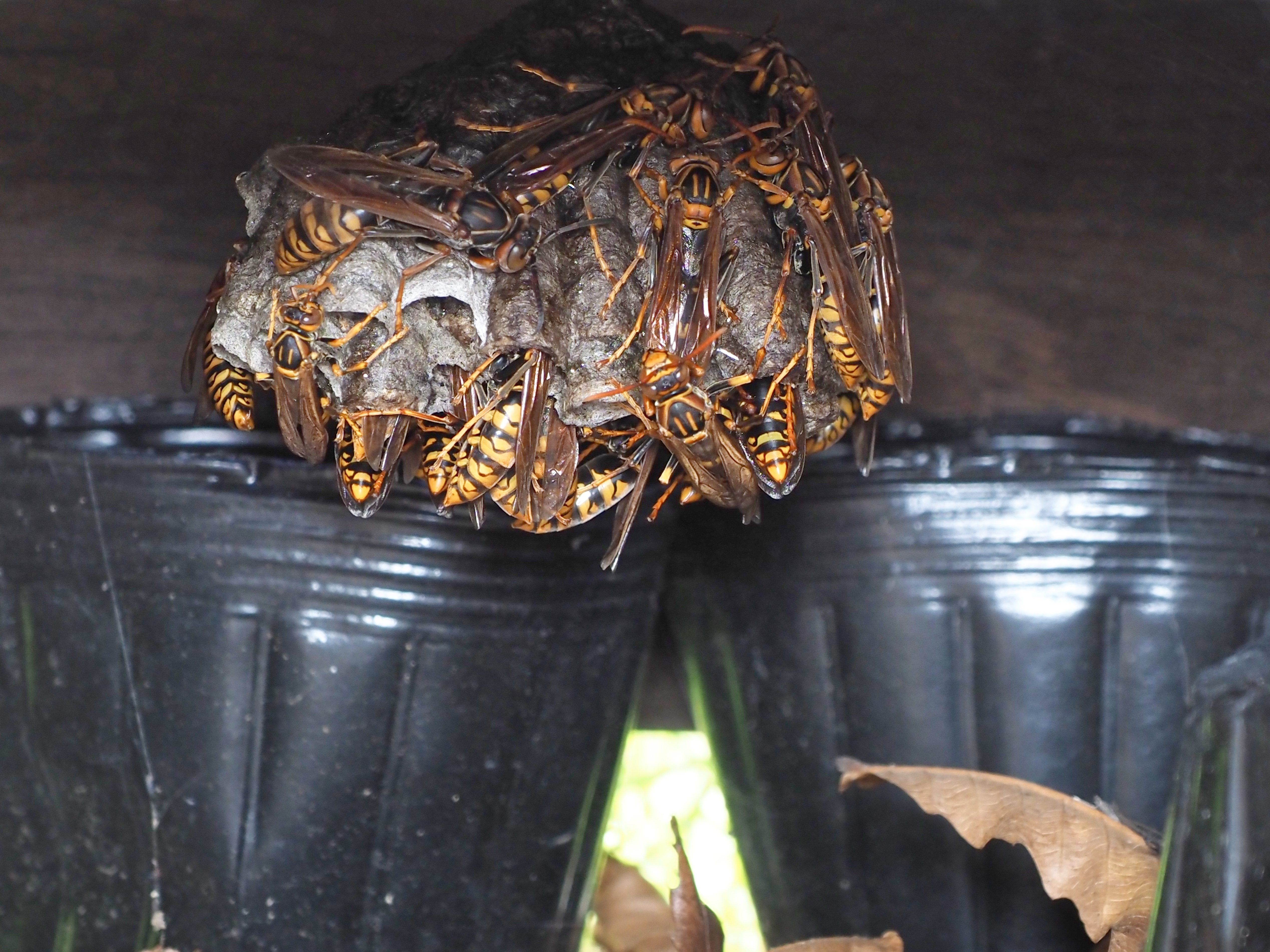
Slim Body, Open Umbrella Nest
- Long, thin body, brown or black with yellow or reddish marks
- Legs dangle below it in flight
- Open comb you can see into, hanging from a short stalk
Paper wasps are the ones building under your deck rail, porch ceiling, gutter or grill cover. They mostly leave people alone unless the nest is touched — but nests by doors and railings get touched a lot.

Stocky, Bright, and Hidden
- Short, thick body with sharp yellow-and-black bands
- Fast, side-to-side flight
- Steady stream of insects into one hole — ground, wall, siding
Yellow jackets are the ones at your soda can and trash can in August. Their nests are hidden, so people stumble onto them by mowing, weeding or opening a shed. They defend the nest hard and can sting more than once.
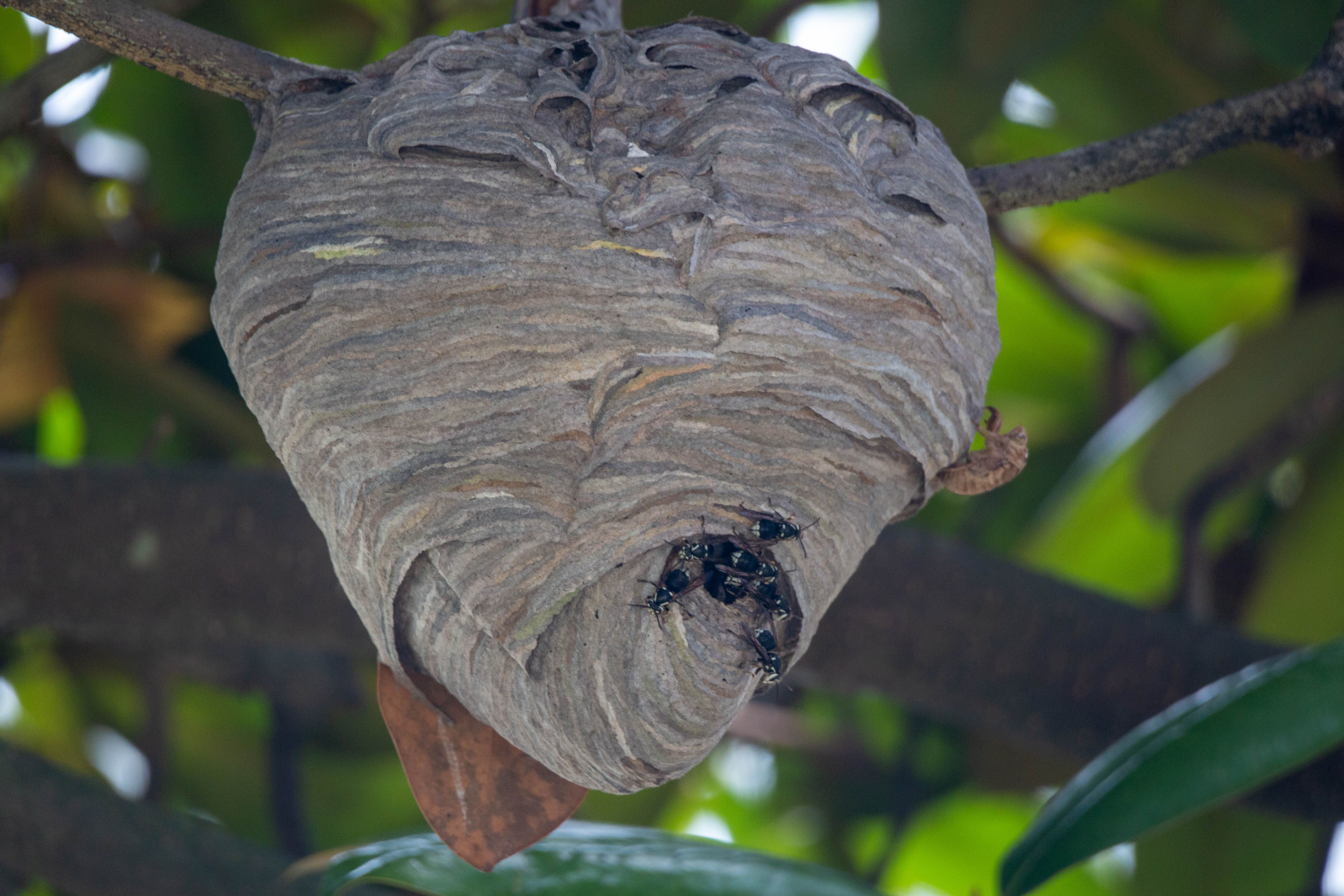
Black & White, Football Nest
- Larger than a yellow jacket, black with an ivory-white face
- Gray, papery, closed nest with one entrance near the bottom
- High in trees, deep in hedges, or under eaves
Despite the name, the bald-faced hornet is actually a type of yellow jacket. It's very protective of its nest and will chase people who get too close or shake the branch.
Paper wasp vs. yellow jacket vs. hornet: side by side
Use this table when you can see the insect or the nest from a safe distance:
| Paper wasp | Yellow jacket | Bald-faced hornet | European hornet | |
|---|---|---|---|---|
| Size | Medium, slender | Small to medium, stocky | Large | Very large |
| Colors | Brown or black with yellow or reddish marks | Bright yellow and black bands | Black with white face and markings | Brown and yellow-orange |
| Flight | Slow, legs hanging down | Fast and darting | Steady, direct | Heavy; may fly at night and come to lights |
| Nest | Open, single comb, no cover | Covered paper nest, usually hidden | Covered gray paper ball or football | Covered paper nest inside hollow trees or wall voids |
| Where | Eaves, deck rails, porch ceilings, sheds | Ground holes, walls, attics, crawl spaces | Trees, shrubs, sides of buildings | Hollow trees, barns, attics, walls |
| Colony size | Small | Can reach thousands by late summer | Hundreds | Hundreds |
| Temper | Mild unless the nest is touched | Very defensive, worst in fall | Very defensive, will chase | Defensive near the nest |
The bald-faced hornet and the European hornet are the only two "hornets" most people in North Jersey will see. If you have a big brown-and-yellow insect bumping into your porch light at night, it's likely a European hornet. Still not sure? Text a photo to 973-510-2585.
What does a hornet nest look like? Nests at a glance
Paper wasp nest
Gray, open honeycomb hanging from one thin stalk — no outer cover, so you can see the cells. Usually palm-sized or smaller, under something that keeps the rain off.
Hornet nest
A closed, gray paper ball or upside-down teardrop with swirled layers on the outside and one opening near the bottom. Can grow larger than a basketball by late summer.
Yellow jacket nest
You rarely see it. Look for one hole in the lawn, a gap in siding or a vent with insects flying straight in and out. The paper nest itself is inside the ground or wall.
Mud dauber nest
Tubes or lumps of dried mud on walls, garage ceilings and under eaves. Mud daubers are solitary and rarely sting; old empty nests can just be scraped off.
Ground bees: what's really nesting in your lawn
When someone in North Jersey says they have “ground bees,” it's usually one of three things:
- Yellow jackets — one hole, often hidden in grass, under a shrub or along a wall, with constant traffic all summer. These are the dangerous ones, and they're most of what we treat.
- Solitary ground-nesting bees — lots of small holes with little dirt mounds in bare patches in early spring. They rarely sting, they help pollinate, and they're usually gone within a few weeks.
- Cicada killers — very large wasps digging holes in sandy soil, sidewalk edges and gardens in mid-summer. They look scary but rarely sting people. See cicada killer control.
Watch the hole for a minute from several feet away. Many bees going in and out of one single opening points to yellow jackets. Lots of holes with one bee each points to solitary bees. Bumble bees can also nest in old burrows and under sheds — they're fuzzy and slower, and generally only a problem if the nest is right where people walk.
Before you mow: if you've seen insects coming out of the lawn, mark the spot and keep the mower away. Vibration over a yellow jacket nest is the most common way people get stung many times at once.
Other insects people mistake for wasps and hornets
Honeybees
Fuzzy, golden-brown and gentler than wasps. A spring swarm on a branch usually moves on within a day or two. Honeybees are valuable — a local beekeeper may be able to collect a swarm.
Carpenter bees
Big, shiny black bees hovering around decks and eaves in spring, drilling round holes in wood. Males can't sting. See carpenter bee control.
Bumble bees
Large and fuzzy all over with yellow bands. They nest in the ground or under sheds and are usually calm unless the nest is disturbed.
Hover flies
Small yellow-and-black flies that hover over flowers and look like tiny wasps. They have only two wings, big eyes and no stinger.
Staying safe around nests — and what to do if you're stung
Around a nest you've found:
- Keep children and pets away, and move outdoor play and meals somewhere else until the nest is handled.
- Don't throw things at the nest, spray it with a hose, set it on fire or try to knock it down. Hornets and yellow jackets send out many defenders at once.
- Don't plug a hole in the ground or a wall — the colony will look for a new exit, sometimes into the house.
- Avoid mowing, trimming hedges, power-washing or using a leaf blower near the nest.
- Keep lids on trash cans and cover sweet drinks and food outdoors in late summer and fall.
If you're stung: walk away from the nest area calmly but quickly — more insects may follow. Wash the sting with soap and water and use a cold pack to bring down swelling. If a honeybee stung you, scrape the stinger out sideways with a fingernail or card.
Call 911 right away for trouble breathing, swelling of the face, lips or throat, dizziness, hives spreading over the body, or many stings at once — especially in a child or someone with a known allergy. Talk to your doctor about stings if you're unsure.
How to get rid of yellow jackets (and what doesn't work)
Identify the nest
Find the single entrance by watching where the insects fly at dusk from a safe distance. Don't go poking around shrubs or holes.
Skip the risky DIY fixes
Gasoline, fire, boiling water and plugging the hole are dangerous and often leave much of the colony alive and angry.
Have the nest treated
A licensed technician in protective gear treats directly into the nest entrance, where the product reaches the colony, including the queen.
Reduce what draws them
Tight trash lids, covered food and drinks, picked-up fallen fruit, and sealed gaps in siding make your yard less inviting next year.
Related stinging insect pages
Found a Nest? Get a Quote
Tell us what you're seeing and where — a photo from a safe distance helps us identify it fast.
When to call a professional
- Yellow jackets coming from the ground or a wall
- A hornet nest in a tree, hedge or under the eaves
- A nest near a door, deck, play area or business entrance
- Anyone in the house allergic to stings
- Nests that keep coming back every summer
Request Service
🔒 Your info stays private · Hablamos español.
Wasp, Hornet & Yellow Jacket ID FAQ
What does a hornet nest look like?
A bald-faced hornet nest is a closed, gray, papery ball or teardrop with one opening near the bottom, usually in a tree, a hedge or under an overhang. It can be bigger than a basketball by late summer.
What's the difference between a paper wasp and a yellow jacket?
Paper wasps are slim with long dangling legs and build open umbrella-shaped nests under overhangs. Yellow jackets are stocky and bright yellow and black, and they hide their nests in the ground or in walls.
Is a bald-faced hornet a real hornet?
Not technically. It's a large type of yellow jacket, named for its black-and-white coloring and its hornet-like size.
What are ground bees?
In New Jersey, most ground bees are yellow jackets nesting in old burrows in the lawn. True ground-nesting bees make many small holes in bare soil in spring and rarely sting.
How do I get rid of yellow jackets?
The safest way is to have a licensed professional treat the nest directly at its entrance. Don't plug the hole, pour gasoline or use fire — those methods are dangerous and often fail.
Which stinging insect is the most aggressive in NJ?
Yellow jackets and bald-faced hornets are the most defensive. Yellow jackets get especially aggressive in late summer and fall as their colonies peak.
Do wasps reuse old nests?
Generally no. Paper wasp, yellow jacket and hornet colonies die off in winter, and new queens usually build a fresh nest in spring, sometimes close to the old one.
When are wasps most active in New Jersey?
From late spring to the first hard frost, with the biggest nests and most stings in August, September and early October.
Can I leave a paper wasp nest alone?
If it's small and well away from doors and walkways, you may choose to. If it's where people or pets go, have it removed.
Who removes wasp and hornet nests near me?
Silver Bullet Pest Control removes wasp, hornet and yellow jacket nests across Bergen, Passaic, Essex and Hudson counties. Call or text 973-510-2585.
¿Cómo sé si es avispa, avispón o yellow jacket?
Mande una foto del insecto o del nido al 973-510-2585 y le decimos qué es. Hablamos español.
Wasp and hornet nest removal near you
Based in Garfield, we identify and remove stinging insect nests in these towns and across Bergen, Passaic, Essex and Hudson counties.
Updated October 2026 by the Silver Bullet Pest Control team, Garfield, NJ • NJ License 90568B