Silver Bullet Pest Control logoSilver Bullet Pest Control
Yellow Jackets & Wasps Β· Hawthorne Β· Passaic County

Yellow Jacket Removal in Hawthorne, NJ

Yellow jackets pouring out of a hole by the fence, chewing into a wall, or crashing your backyard barbecue? Silver Bullet Pest Control finds and treats yellow jacket and wasp nests for Hawthorne homes, from the ground nest the lawnmower found to the colony buzzing behind the siding. Based in Garfield, we serve Hawthorne and the rest of Passaic County.

4.9 stars on Google β€’ NJ License 90568B β€’ 15+ years β€’ Same-day visits often available β€’ Hablamos espaΓ±ol

Text a photo or short video of the nest entrance to 973-510-2585 and we'll tell you what you're dealing with.

How do I get rid of yellow jackets in Hawthorne, NJ?

The safest way to get rid of yellow jackets in Hawthorne is to have a licensed technician find the nest entrance and treat the colony directly, because killing the workers you see outside doesn't stop a nest that keeps growing until frost. Silver Bullet Pest Control treats ground, wall and tree nests, removes exposed nests that can be reached, and checks for more on the property. Same-day visits are often available. NJ License 90568B, 4.9 stars on Google. Call or text 973-510-2585.

Know your yellow jacket

Yellow jackets are social wasps. Each colony starts in spring with one queen who survived the winter. She builds a small paper nest, raises the first workers, and from then on the workers do all the building and foraging. By late summer a single nest can hold thousands of yellow jackets.

Three things make them different from the paper wasps most people picture:

  • The nest is usually hidden. Most yellow jackets in North Jersey nest underground or inside walls, so all you see is a hole with traffic.
  • They defend hard. Disturb the entrance and many workers come out at once, and each one can sting more than once.
  • They want your food. In late summer they go after sweets, meat and open drinks, which is why picnics and trash cans attract them.

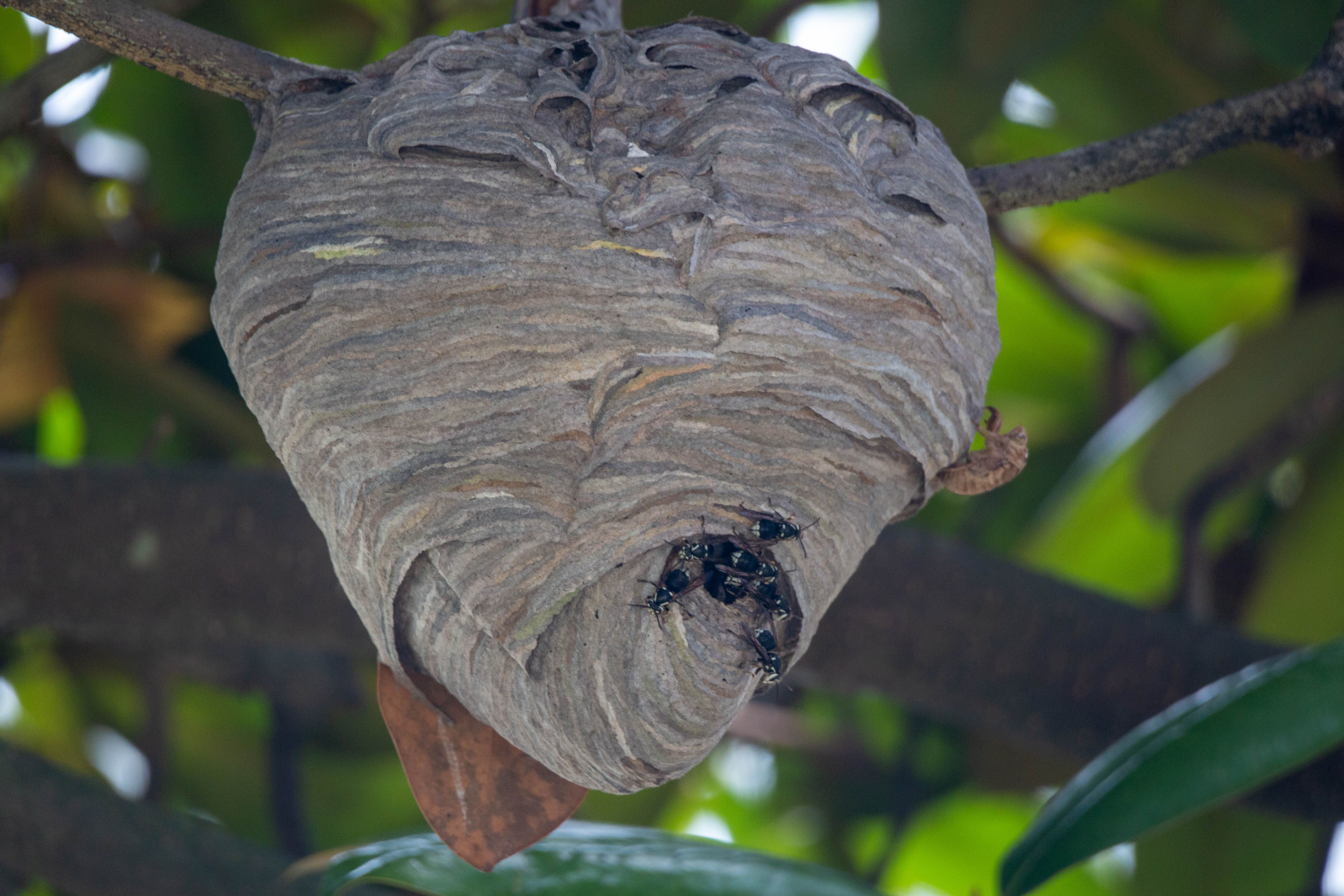
The bald-faced hornet, the black-and-white insect that builds gray paper balls in trees, is actually a kind of yellow jacket too, and it's just as protective of its nest.

Where yellow jackets and wasps nest on Hawthorne properties

Hawthorne is mostly single-family homes with backyards, and these are the spots we check:

Cracks in a masonry wall where insects can get in
Walls and siding

Inside the house

  • A single gap with steady traffic
  • Buzzing behind a wall or ceiling
  • Stains or soft spots in drywall

Gaps at the foundation line, under siding, around vents and at the roofline lead into hollow walls and soffits, where a colony can grow all summer unseen.

Gray paper hornet nest hanging from a tree branch
Aerial nests

Trees, shrubs and eaves

  • Gray, layered paper ball
  • Black-and-white or yellow-and-black workers
  • Often found when trimming hedges

Bald-faced hornets and some yellow jackets build above ground in trees, hedges, sheds and under eaves. Many aren't noticed until a ladder or hedge trimmer gets close.

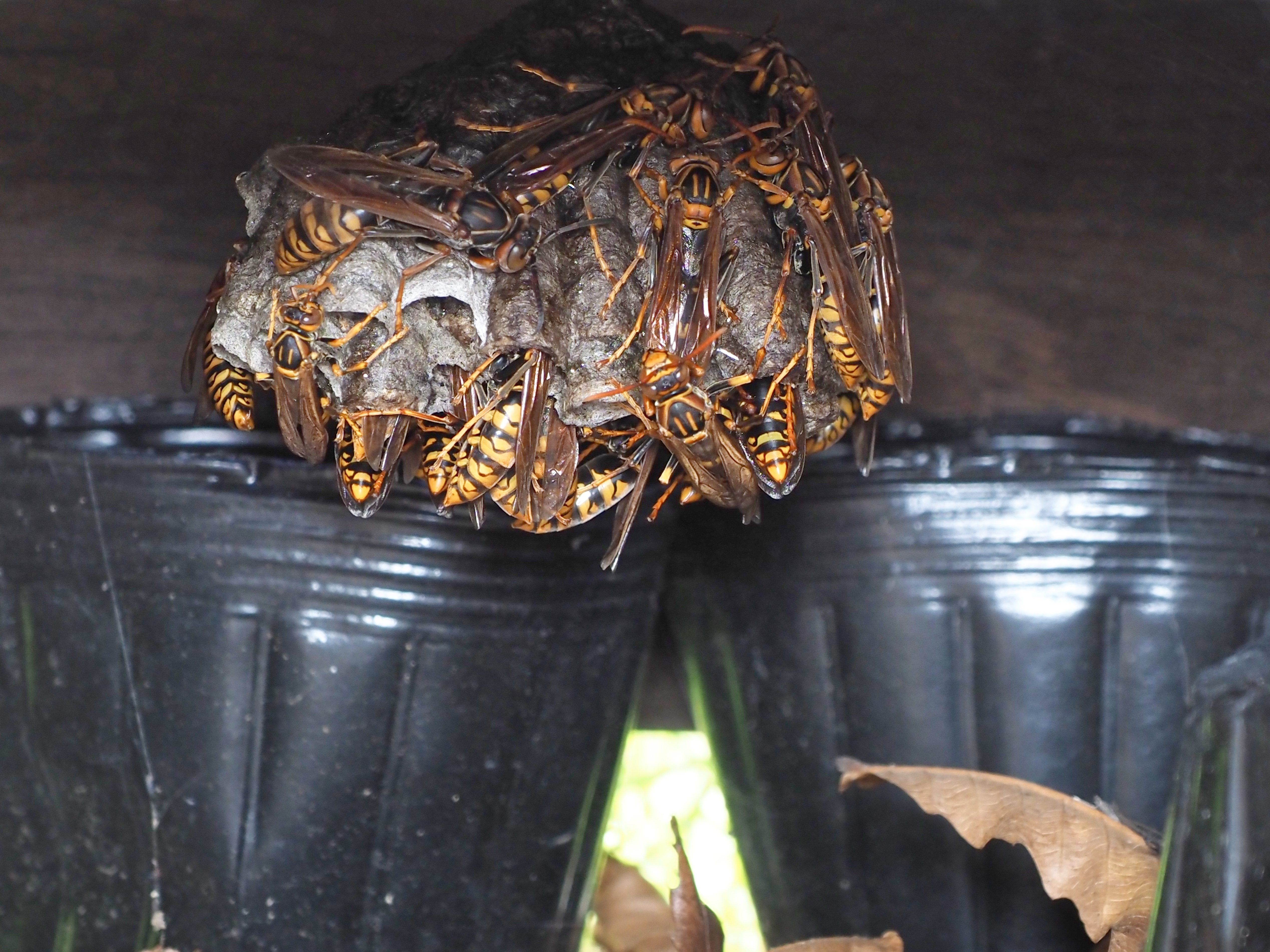
Open paper wasp nest with visible cells
Look-alike

Paper wasps

  • Open comb with visible cells
  • Hangs under porch roofs and railings
  • Slimmer wasps with long dangling legs

Paper wasps get mistaken for yellow jackets all the time. They're usually calmer and their nests are smaller and easier to remove, but one over a door still needs to go.

What the signs usually mean

Use this to sort out what you're seeing before you go near it:

What you noticeWhat it usually meansWhat to do
A steady line of insects in and out of one hole in the lawnAn underground yellow jacket colonyFlag it, keep everyone away, don't mow over it
Insects flying into a gap in siding, brick or a ventA colony inside the wall or soffitDon't seal the gap; call for treatment
Yellow jackets inside, near windows or light fixturesA wall or ceiling nest has found a way inKeep the room closed off and call us
Lots of yellow jackets at the trash or patio table, no nest in sightForagers from a nest nearby, possibly a neighbor's yardCover food; we can look for the nest
A gray paper ball in a tree or shrubBald-faced hornet nestStay well back; it's very defensive
Small open comb under a railing or porch roofPaper wasp nestLower risk, but don't bump it

Not sure? A 10-second video from a safe distance, sent to 973-510-2585, usually tells us what it is.

When the nest is inside the wall

Wall nests are the calls that worry people most, and for good reason. Yellow jackets in a wall void keep expanding the nest by chewing away whatever is around them, and a large colony can chew through drywall or a ceiling into the room.

Signs a colony is inside: a scratching or crackling sound in the wall, a warm or damp spot, a stain on a ceiling, or yellow jackets showing up indoors near light fixtures, outlets or windows.

What not to do: don't caulk, foam or tape the outside hole. With their exit blocked, the colony looks for another way out, and that's often into the house. Don't spray into the gap with a store can either; it rarely reaches the nest and stirs them up.

What we do: treat the colony through the entrance they're using, confirm activity has stopped, and then point out or seal the gap so next year's queen doesn't move into the same space. If it isn't wasps at all (honey bees sometimes nest in walls too), we tell you, and we work with a local beekeeper to relocate them.

Hawthorne yard hot spots

🌳

Fence lines and tree roots

Old rodent holes and gaps under roots and fence posts are favorite ground nest sites, especially along back property lines and near wooded areas like Goffle Brook Park.

🧱

Retaining walls and steps

Stacked stone, block walls and concrete steps have hollow spaces yellow jackets can move into.

πŸ›

Sheds, decks and play sets

Undersides of decks, shed eaves and the inside of play-set tubes are sheltered and close to where kids spend time.

πŸ—‘οΈ

Trash and recycling

Open bins and sticky cans draw foragers in August and September, even when the nest is somewhere else.

A quick walk around the yard in May, when nests are still small, can save you a much bigger problem in September.

How we treat a yellow jacket colony

1

Find every entrance

We watch flight paths to find the main entrance and any second opening, and check the rest of the property for other nests.

2

Treat the colony

A licensed technician in protective gear treats the nest at the entrance so returning workers carry it into the colony.

3

Remove what we can

Exposed nests in shrubs, eaves and sheds are taken down once activity stops. Ground and wall nests are left in place to die off.

4

Close it up

We tell you when it's safe to fill a ground hole or seal a wall gap, and can seal openings so the spot isn't reused. See entry point sealing.

You may see some activity for a day or two as workers return. If it doesn't drop off, call us.

Late summer: keeping yellow jackets off the patio

From mid-August until the first hard frost, yellow jackets are at their most annoying. Colonies are at peak size, and workers spend more time looking for sugar. That's when they find your soda, fruit, grilled meat and garbage.

  • Serve drinks in cups with lids or use straws, and check a can before you sip.
  • Bring food out right before eating and cover it between servings.
  • Keep grills clean and bin lids tight, and move trash cans away from doors and seating.
  • Pick up fallen fruit under trees.
  • Hang traps away from where people sit, not on the table. Traps catch foragers but won't get rid of a nest.

If yellow jackets keep showing up in large numbers, there's almost always a nest within a short distance. That's the part we can fix.

What affects the price of yellow jacket control

Quotes are free. Here's what moves the price up or down:

FactorSimpler jobMore involved job
Nest locationOne ground nest in the openInside a wall, ceiling or high soffit
Number of nestsOneSeveral around the property
SeasonLate spring, small colonyAugust or September, peak size
AccessReachable from the groundLadder work, tight spaces or stone walls
ExtrasNothing else neededSealing gaps or a follow-up visit

Call or text 973-510-2585 with a photo and where the nest is.

Get a Free Yellow Jacket Quote in Hawthorne

Tell us where the nest is and send a photo or video if you can. Same-day visits are often available.

Why Hawthorne calls us for yellow jackets

  • A ground nest found by the lawnmower
  • Yellow jackets going into the siding or a vent
  • Yellow jackets showing up inside the house
  • A hornet nest in a tree or hedge
  • Someone at home is allergic to stings
πŸ“ž Call 973-510-2585

Request Service

πŸ”’ Your info stays private Β· Hablamos espaΓ±ol.

What's bugging you? - Step 1 of 3

Yellow Jacket Questions from Hawthorne

How do I know if it's yellow jackets or bees?

Yellow jackets are shiny, hairless and bright yellow and black; bees are fuzzy. A single busy hole in the ground is almost always yellow jackets. Text us a photo.

Can I just fill in the hole?

No. Filling or blocking an active hole makes the colony dig another exit, and in a wall that exit can be into your house. Treat first, then fill or seal.

How long until the yellow jackets are gone after treatment?

Activity usually drops off within a day or two as returning workers contact the treatment. If it doesn't, call us.

Do yellow jackets die in winter?

Yes. The workers and the old queen die with hard frost; only new queens survive the winter, hidden away, and they start new nests in spring.

Will they reuse the same nest next year?

No, but a good spot can attract a new queen. Sealing the gap after treatment helps.

Is it safe for my kids and dog?

We explain where we treat and any precautions before we start, and tell you when the area can be used again.

Can you come today?

Same-day visits are often available, especially for nests near doors or someone allergic. Call or text 973-510-2585.

Why do yellow jackets keep coming to my yard if I can't find a nest?

Foragers travel from nearby nests, sometimes in a neighbor's yard. We can look for it, and covering food and trash helps in the meantime.

Are you licensed?

Yes. Silver Bullet Pest Control holds NJ License 90568B and has over 15 years of experience.

ΒΏHablan espaΓ±ol?

SΓ­. Hablamos espaΓ±ol. Llame o mande un texto al 973-510-2585.

Wasp and yellow jacket help near Hawthorne

From our base in Garfield we serve Hawthorne and towns across Passaic and Bergen counties.

Recent jobs near Hawthorne, NJ

Real photos from our recent jobs. We show only the street and town, never the customer's exact address.

Bee & wasp removal – Midland Park, NJ
Bee & wasp removalπŸ“ Highwood Ave Β· Midland Park, NJ Β· Sep 2026

Bee & wasp removal for a home on Springfield Avenue in Summit, NJ by Silver Bullet Pest Control.

Rat & mouse control – Paterson, NJ
Rat & mouse controlπŸ“ 3rd Ave Β· Paterson, NJ Β· Oct 2026

Rat & mouse control for a home on Mackay Avenue in Paramus, NJ by Silver Bullet Pest Control.

Squirrel & raccoon exclusion – North Haledon, NJ
Squirrel & raccoon exclusionπŸ“ N Haledon Ave Β· North Haledon, NJ Β· Oct 2026

Squirrel & raccoon exclusion for a home on N Haledon Ave in North Haledon, NJ by Silver Bullet Pest Control.

Rat & mouse control – Elmwood Park, NJ
Rat & mouse controlπŸ“ Mola Blvd Β· Elmwood Park, NJ Β· Nov 2026

Rat & mouse control for a home on Mola Blvd in Elmwood Park, NJ by Silver Bullet Pest Control.

Squirrel & raccoon exclusion – Paterson, NJ
Squirrel & raccoon exclusionπŸ“ East Main Paterson Β· Paterson, NJ Β· Nov 2026

Squirrel & raccoon exclusion for a home on East Main Paterson in Paterson, NJ by Silver Bullet Pest Control.

Damage repair & sealing – Elmwood Park, NJ
Damage repair & sealingπŸ“ Philip Ave Β· Elmwood Park, NJ Β· Aug 2026

Damage repair & sealing for a home on Philip Ave in Elmwood Park, NJ by Silver Bullet Pest Control.

Our service area

Union County

973-510-2585
  • Berkeley Heights
  • Clark
  • Cranford
  • Elizabeth
  • Fanwood
  • Garwood
  • Hillside
  • Kenilworth
  • Linden
  • Mountainside
  • New Providence
  • Plainfield
  • Rahway
  • Roselle
  • Roselle Park
  • Scotch Plains
  • Springfield
  • Summit
  • Union
  • Westfield

Morris County

973-510-2585
  • Boonton
  • Butler
  • Cedar Knolls
  • Chatham
  • Denville
  • Dover
  • East Hanover
  • Florham Park
  • Hanover
  • Kinnelon
  • Lincoln Park
  • Madison
  • Mendham
  • Montville
  • Morris Plains
  • Morristown
  • Mountain Lakes
  • Parsippany
  • Pequannock
  • Randolph
  • Riverdale
  • Rockaway
  • Roxbury
  • Whippany

Updated November 2026 by the Silver Bullet Pest Control team, Garfield, NJ β€’ NJ License 90568B

Scroll to Top