
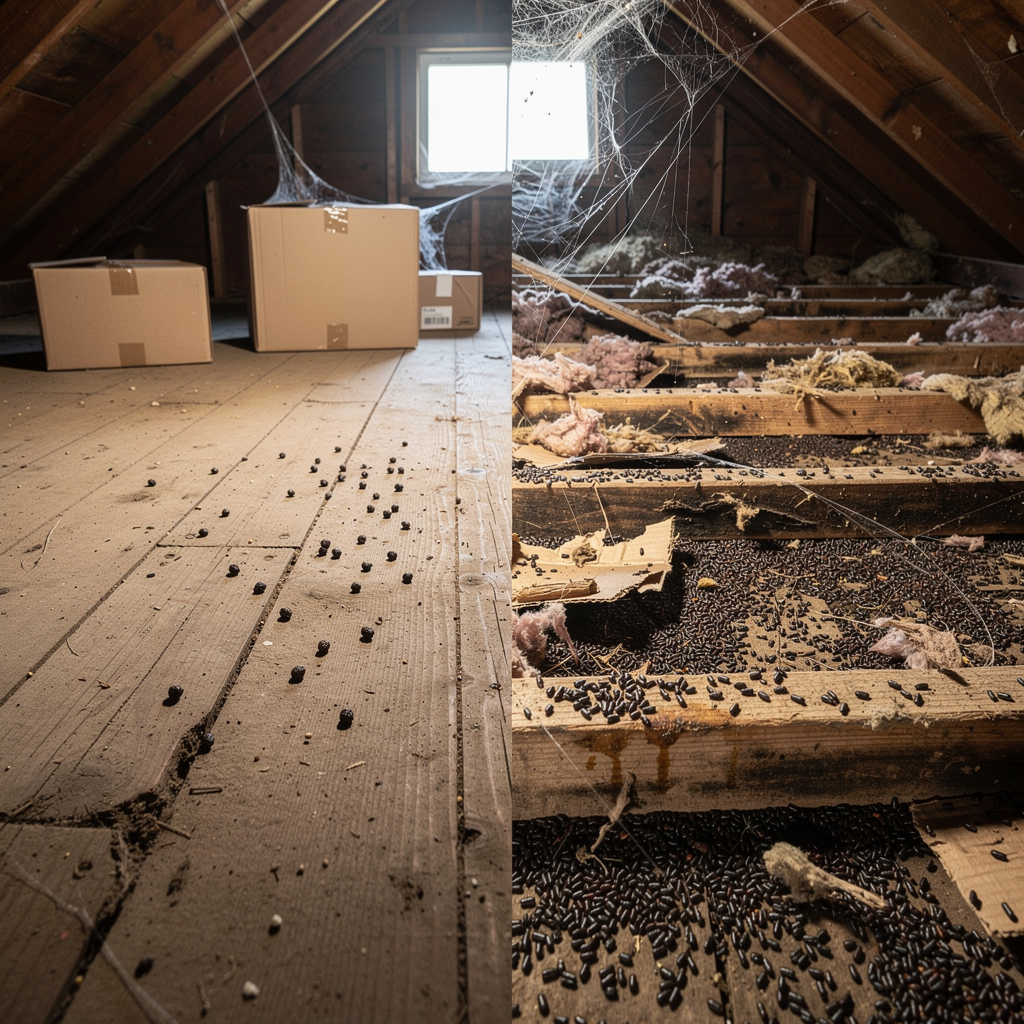
How much and how fresh
- A few pellets vs. many
- Fresh and dark vs. old and dry
- Where they cluster
The amount and age of droppings tell us how big the problem is and whether it's still active.
 Silver Bullet Pest Control
Found a few droppings in a kitchen drawer, or heard something in the ceiling at night? A home mouse inspection tells you if you really have mice, how many, and exactly how they're getting in. Silver Bullet Pest Control inspects Irvington houses, two-families and apartments and gives you a clear plan and a free quote.
4.9 stars on Google • NJ License 90568B • Over 15 years of experience • Serving Essex County • Hablamos español
Text a photo of what you found (with a coin for size) to 973-510-2585. We'll tell you if it's mice.
A home mouse inspection in Irvington, NJ is a room-by-room and outside check that confirms whether you have mice, shows where they're nesting and traveling, and finds every gap they use to get in. Silver Bullet Pest Control checks the kitchen, basement, utility lines, walls, attic access and foundation, then explains a plan to remove the mice and seal the entry points, with a free quote. Call or text 973-510-2585.
Small, dark, rice-shaped pellets in drawers, under the sink, behind the stove or along baseboards.
Light scratching or running inside walls or ceilings after the house goes quiet.
Nibbled food packages, shredded paper towels, chewed wires or holes in boxes.
A cat or dog staring at one spot in the wall or the bottom of a cabinet.
Saw just one mouse? Read does one mouse mean more. It usually does, and an inspection tells you how many and where.
Irvington is a busy, densely built town in Essex County, right next to Newark, with a lot of older two-family and multi-family homes, attached and closely spaced houses, and small apartment buildings along streets like Springfield Avenue. Those older homes are full of the small gaps mice use, and in a building with shared walls, mice don't stay in one unit.
That's why a good inspection looks at the whole house, not just the room where you saw the droppings:
You tell us what you've seen, where and since when. We ask about kids, pets and other units in the building.
We go room by room looking for droppings, nests, chew marks, grease marks along walls and travel paths.
We walk the foundation and look at every way a mouse could get in, even gaps the size of a pencil.
We show you what we found, explain how many mice it likely is and where they get in, and give you a free quote.
If you go ahead, mouse service includes 90 days of coverage with unlimited free service calls in that time.
An inspection is only useful if you understand what was found. After we check your home, you'll know:
Removal is done with traps placed along the paths mice really use and out of reach of kids and pets. Gaps are sealed with materials mice can't chew through. Learn more on our main mouse and rat control page and our rodent proofing and exclusion page.
The amount and age of droppings tell us how big the problem is and whether it's still active.

A mouse fits through a gap about the width of a pencil. We find the ones that matter.

Nests show us where to focus. Mice in the attic need a slightly different approach.
In a two-family or apartment building, mice travel through shared walls, ceilings, pipe chases and the basement. If only one unit is treated, the mice often just move next door and come back later. For multi-family homes we look at the unit with the problem, the basement and the trash area, and, when we can get access, the units next to it.
Tenants: tell your landlord or building manager in writing, with dates and photos. Owners: one building-wide plan usually costs less than treating unit by unit over and over. Our landlord and tenant pest control guide explains the basics, and rules can differ by building type and town, so check with your town's code enforcement office if you're unsure. Owners can also see our apartment building pest control programs.
| What you find | Likely mice | Likely rats | Maybe something else |
|---|---|---|---|
| Droppings | Rice-sized, pointed | Raisin-sized or bigger, blunt | Very small specks may be roach droppings |
| Noise | Light scratching in walls at night | Heavier thumping, low in the house | Loud running in the attic in the morning may be squirrels |
| Damage | Small holes in food packages | Larger gnawed holes, chewed plastic | Torn soffit or vent may be wildlife |
| Outside | Usually nothing visible | Burrows along the foundation | Holes in the roof line |
Not sure? Text us a photo. For the other possibilities, see roach control in Irvington and noises in the attic.
We give a free quote once we've looked at the home. These are the things that change the price:
| Factor | Usually a smaller job | Usually a bigger job |
|---|---|---|
| Activity | A few droppings in one room | Droppings in several rooms and floors |
| How long | Just noticed | Months of activity, nests in walls or attic |
| Building | Single-family home | Two-family or apartment building |
| Entry points | A few small gaps | Many gaps at the foundation, pipes and vents |
| Access | Open basement | Finished basement, tight crawl spaces, locked units |
Call or text 973-510-2585 to set up an inspection. Same-day appointments are often available in Essex County.
Tell us what you're seeing and where, and send a photo if you can. We'll set up the inspection, explain what we find and give you a free quote.
🔒 Your info stays private · Hablamos español.
A home mouse inspection checks the kitchen, basement, living areas, attic access and the outside of the house. We look for droppings, nests, chew marks and travel paths, and find every gap mice use to get in. Afterward we explain what we found and give you a plan and a free quote.
Most homes take somewhere around 30 minutes to an hour, depending on the size of the house, how many floors and units there are, and how easy the basement and attic are to reach. Two-families and apartment buildings take longer because we check more areas.
Mouse droppings are small and pointed like grains of rice. Rat droppings are bigger and blunt, about the size of a raisin. Mice make light scratching sounds, while rats are louder and heavier. If you're not sure, text us a photo with a coin next to it for size.
The quote is free. Call or text 973-510-2585 and we'll explain how the visit works for your home and what's included. If you decide to go ahead, mouse service includes 90 days of coverage with unlimited free service calls in that time.
Yes. Irvington is in Essex County, one of the four core counties we serve from our base in Garfield, along with Bergen, Passaic and Hudson. Same-day appointments are often available. Call or text 973-510-2585 to set up an inspection.
Yes. In two-families, attached homes and apartment buildings, mice travel through shared walls, ceilings, pipe chases and basements. That's why we look at the whole building when we can. Treating only one unit often pushes mice next door, and they come back.
As fall nights get colder, mice look for warm places with food and shelter, and a house is perfect. They slip in through small gaps at the foundation, around pipes and under doors. Getting an inspection and sealing gaps in early fall is the best way to stay ahead of it.
You can, but don't move or clean everything away. Droppings and chew marks help us see where mice travel. Avoid loose poison, especially with kids or pets, since mice can die inside walls and smell. Tell us what you've already tried when we arrive.
Mouse droppings and urine can carry germs, so handle them carefully. Don't sweep or vacuum them dry. Wear gloves, spray them with a disinfectant, wait a few minutes, then wipe them up and throw the towels away in a sealed bag. Wash your hands afterward.
Sí. Revisamos la casa por dentro y por fuera, buscamos excrementos, nidos y los huecos por donde entran los ratones, y le explicamos el plan con una cotización gratis. Hablamos español. Llame o mande un texto al 973-510-2585.
We serve Irvington and the rest of Essex County, plus Bergen, Passaic and Hudson, from our base in Garfield.
Updated November 2026 by the Silver Bullet Pest Control team, Garfield, NJ • NJ License 90568B