Silver Bullet Pest Control logoSilver Bullet Pest Control
Ant Guide Β· North Jersey

21 Ant Fun Facts (That Won't Make You Want Them in Your Kitchen)

Ants are some of the most organized, toughest and strangest animals on the planet. Here are 21 ant fun facts, from all-female workforces to queens that live for years, plus what each one means when ants show up on your kitchen counter in New Jersey.

4.9 stars on Google β€’ NJ License 90568B β€’ 15+ years β€’ Based in Garfield β€’ Hablamos espaΓ±ol

Not sure which ant you have? Text a photo to 973-510-2585 and we'll tell you.

What are some fun facts about ants?

Ant fun facts start with this one: almost every ant you see is a sterile female worker, sent out by a queen who may live for years hidden in the nest. Ants also smell with their antennae, share food mouth-to-mouth through a "social stomach," lay scent trails that the whole colony follows, and can carry many times their own body weight. That trail habit is exactly why a single crumb can turn into a line of ants across your counter by morning.

Ant fun facts about life in the colony

An ant colony works more like one big animal than a crowd of separate bugs. These four facts explain why:

πŸ‘‘

1. The queen is an egg factory, not a boss

The queen doesn't give orders. Her job is laying eggs, sometimes for many years. In some species a queen can live well over a decade, which is why killing the ants you see rarely ends the problem.

♀️

2. Every worker is female

The ants marching across your floor, guarding the nest and feeding the young are all sterile females. Males show up only for a short time each year, and their one job is mating.

πŸͺ½

3. Wings are only for moving out

Winged ants (called swarmers or alates) are young queens and males leaving to start new colonies. After mating, a new queen breaks off her wings and digs in. Winged ants indoors can mean a nest inside the building.

🏠

4. Some colonies have many queens

Odorous house ants, pharaoh ants and Argentine ants can keep several queens in one colony. Colonies like that can split into new nests, which makes them much harder to get rid of.

Seeing a few workers is the tip of the iceberg. The queen, eggs, larvae and most of the colony stay out of sight in a wall, under a slab or in the yard.

Ant body facts that sound made up

πŸ“‘

5. They smell with their antennae

Those constantly moving antennae pick up smell, taste, touch and vibration. Ants use them to recognize nestmates, follow trails and find your sugar bowl.

🫁

6. Ants have no lungs

Air moves in and out through tiny holes along the sides of the body called spiracles. There's no nose and no lungs at all.

🍯

7. They have a "social stomach"

Ants carry liquid food in a crop, sometimes called a social stomach, and pass it mouth-to-mouth to other ants. One forager can feed many nestmates, which is how bait spreads through a colony.

πŸ‹οΈ

8. They lift far more than they weigh

Depending on the species, an ant can carry many times its own body weight. Hauling a crumb several times its size back to the nest is normal work.

Fun facts about the ants we see in New Jersey homes

Thousands of ant species exist worldwide, but a few do most of the bothering in North Jersey houses:

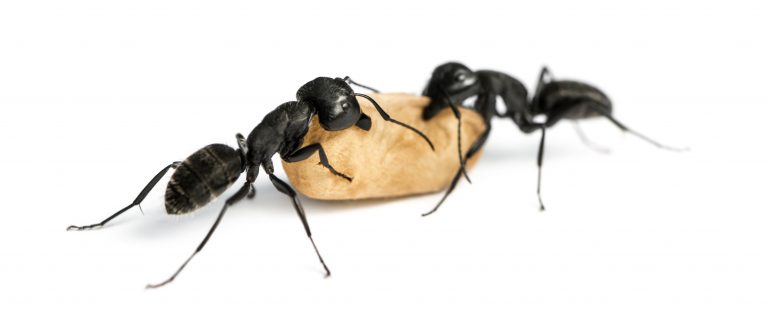
Two large black carpenter ants on wood
Wood and walls

Carpenter ants

  • Large, mostly black ants
  • Little piles of sawdust (frass)
  • Ants inside in late winter or early spring

9. Carpenter ants don't eat wood. They chew it out to make tunnels and push the shavings out as frass, which often contains bits of dead insects. They like wood softened by water, so leaks, old window frames and porch beams are favorite spots.

Small dark ants gathered together
Kitchens and baths

Odorous house ants

  • Tiny brown or black ants
  • Trails along counters and sinks
  • Smell when crushed

10. Crush one and it gives off a sour smell many people compare to rotten coconut. They love sweets, show up in kitchens after rain, and can run many queens per colony.

Commercial kitchen counters and floor
Slabs and sidewalks

Pavement ants

  • Small dark ants with grooved heads
  • Little dirt piles at sidewalk cracks
  • Ants coming up through slab cracks

11. In spring, neighboring pavement ant colonies sometimes fight huge battles on sidewalks and driveways, with thousands of ants wrestling at once. Indoors they come up through cracks in basement floors and slabs.

How ants find your food (facts 12–16)

12. Scouts go first. A colony sends out scouts that wander until they find food or water. A successful scout heads home laying a scent trail, called a pheromone trail, as she goes.

13. The trail gets stronger the more it's used. Every ant that finds food on that trail adds more scent on the way back. That's why you can go from one ant at night to a highway of them by breakfast.

14. Ants clean up their dead. Many species carry dead nestmates and trash out of the nest to a dump pile. It's one of the ways a colony keeps disease from spreading.

15. Some ants farm other insects. Ants protect aphids and similar insects on plants and "milk" them for honeydew, a sugary liquid. Aphids on shrubs next to the house can keep an ant colony well fed right outside your door.

16. Spraying can split a colony. With pharaoh ants and some other multi-queen species, a spray that kills part of the colony can cause the survivors to move and start several new nests. Pest pros call it budding, and it's the main reason store sprays can make an ant problem worse.

Want the details? See our page on ant bait vs. ant spray.

What these ant facts mean for your kitchen

Here's how the fun facts turn into real-life advice:

Ant factWhat it means at homeWhat to do
Ants follow scent trailsWiping up ants without cleaning the trail brings moreClean the path with soap and water, not just the ants
The queen stays hiddenKilling the ants you see doesn't end the colonyUse slow baits or have a pro find and treat the nest
Food is shared mouth-to-mouthSlow-acting bait reaches the queen and youngDon't spray over bait or wipe it away
Some colonies split when stressedStore sprays can create more nestsAvoid repellent sprays on multi-queen ants
Carpenter ants like wet woodIndoor carpenter ants can point to a leakFix leaks and have damaged wood checked
Winged ants leave to start coloniesSwarmers indoors may mean a nest insideSave one and compare it with a termite

Flying ants and termite swarmers look alike at first glance. Our guide to flying ants vs. termite swarmers shows how to tell them apart.

Odd ant facts to share at dinner (17–21)

πŸ¦–

17. Ants are ancient

Ants have been around since the age of dinosaurs. Some of the oldest known ants are preserved in amber that is roughly 100 million years old.

🌍

18. There are a lot of them

A 2022 scientific estimate put the number of ants on Earth at roughly 20 quadrillion. That's about two and a half million ants for every person.

πŸ”—

19. Some colonies cover huge areas

Argentine ants can form supercolonies where ants from nests far apart treat each other as family instead of fighting. One in southern Europe stretches for thousands of miles.

πŸ„

20. Some ants are farmers

Leafcutter ants in the tropics don't eat the leaves they carry. They use them to grow a fungus garden, and the fungus is their food.

21. Ants don't hibernate the way people think. Outdoor colonies in New Jersey slow down and stay deep in the ground through winter. So if you see ants marching around inside in January or February, the colony is probably living somewhere in the warm building, not outside.

When ant fun facts stop being fun

A few ants on the patio in summer are part of life in New Jersey. These are the times it's worth getting help:

  • Ants keep coming back after you've cleaned, baited and sealed the obvious gaps.
  • Large black ants show up indoors, especially in winter or early spring, or you find little piles of sawdust. That points to carpenter ants nesting in the wood.
  • Winged insects appear inside near windows or the basement and you can't tell if they're ants or termites.
  • Ants are in the kitchen every day and you have small kids, pets or a business with a health inspection coming up.
  • Tiny yellowish ants show up in bathrooms or around outlets; these may be pharaoh ants, which spraying tends to make worse.

If the ants are only in the kitchen, our page on why you have ants in your kitchen covers the usual causes and fixes.

How Silver Bullet uses ant facts to get rid of ants

1

Identify the ant

Different ants need different treatments. We identify the species first, and you can start by texting a photo to 973-510-2585.

2

Find the trail and the nest

We follow the trails back to where they come in and, when possible, to the nest itself, whether it's in a wall, under a slab or out in the yard.

3

Treat with the colony in mind

We use methods that work with ant behavior, so the treatment travels back to the queen instead of just killing the workers you can see.

4

Fix what draws them

We point out leaks, wet wood, food sources and entry gaps. For carpenter ants, we can repair the damaged wood, just like we do after termites.

Want ants handled for good along with other bugs? Our regular home pest control comes with a 100% satisfaction guarantee. Learn more about our ant exterminator service in New Jersey.

Ants not so fun anymore?

Tell us where you see them and what they look like. We'll identify the ant and give you a free quote.

Why North Jersey calls us for ants

  • We identify the ant before treating
  • Treatments aimed at the colony, not just the trail
  • Carpenter ant damage repaired by our own crew
  • 4.9 stars on Google, NJ License 90568B
  • Hablamos espaΓ±ol
πŸ“ž Call 973-510-2585

Request Service

πŸ”’ Your info stays private Β· Hablamos espaΓ±ol.

Questions about ants

Are all worker ants female?

Yes. Every worker ant is a sterile female. Male ants are produced only at certain times of year, they usually have wings, and they live just long enough to mate. So the ants raiding your pantry, guarding the nest and caring for the young are all sisters, daughters of the same queen or queens.

How long do ant queens live?

It depends on the species, but ant queens live much longer than workers. Many live for several years, and in some species a queen can live well over a decade. That long life is why a colony can keep sending ants into your home season after season until the nest itself is dealt with.

Why do ants walk in a straight line?

Ants walk in lines because they follow a scent trail laid by earlier ants. A scout that finds food marks the route home, and each ant that uses it adds more scent. Cleaning the path with soapy water removes the trail and confuses the ants, which is why wiping counters helps.

Do ants sleep?

Ants do rest in short periods, but a colony never fully shuts down; some ants are always working. In New Jersey, outdoor colonies slow way down in winter and stay deep underground. Ants that stay busy inside in the cold months are usually nesting inside the warm building.

Do carpenter ants eat wood?

No. Carpenter ants chew through wood to make tunnels for their nest, but they don't eat it the way termites do. They push the shavings out as little piles of frass. They prefer wood that is damp or already softened, so carpenter ants indoors can also be a sign of a leak.

Why do ants come inside after it rains?

Heavy rain can flood shallow nests and wash away food outdoors, so ants look for dry, food-rich places, and your kitchen qualifies. Odorous house ants are especially known for showing up after rain. Sealing gaps near sinks and cleaning trails usually cuts down rainy-day visits.

Is it bad to spray ants with store-bought spray?

Spraying kills the ants you hit but rarely reaches the queen, and with some multi-queen ants it can cause the colony to split into several new nests. Slow-acting baits that workers carry back to the nest usually work better. Don't spray near bait, or the ants will avoid it.

Are flying ants the same as termites?

No. Flying ants have a pinched waist, bent antennae and front wings longer than the back ones. Termite swarmers have a thick waist, straight antennae and four wings of equal length. If you find winged insects indoors, save one and text a photo to 973-510-2585 so we can identify it.

Can ants damage my house?

Most household ants are a nuisance, not a structural threat. Carpenter ants are the exception: over time their tunnels can weaken wood, especially wood already softened by water. If we find carpenter ant damage, our crew can repair the wood after treatment.

Do you get rid of ants in North Jersey?

Yes. Silver Bullet Pest Control is based in Garfield and treats ants in Bergen, Passaic, Essex and Hudson counties. We hold NJ License 90568B and have over 15 years of experience. Call or text 973-510-2585 for a free quote.

ΒΏAyudan con hormigas en espaΓ±ol?

SΓ­. Hablamos espaΓ±ol y le ayudamos a identificar la hormiga con una foto por texto al 973-510-2585. Vea tambiΓ©n nuestra pΓ‘gina de control de hormigas en NJ.
Ant control across North Jersey

From our base in Garfield we treat ants in these towns and many more.

Our service area

Union County

973-510-2585
  • Berkeley Heights
  • Clark
  • Cranford
  • Elizabeth
  • Fanwood
  • Garwood
  • Hillside
  • Kenilworth
  • Linden
  • Mountainside
  • New Providence
  • Plainfield
  • Rahway
  • Roselle
  • Roselle Park
  • Scotch Plains
  • Springfield
  • Summit
  • Union
  • Westfield

Morris County

973-510-2585
  • Boonton
  • Butler
  • Cedar Knolls
  • Chatham
  • Denville
  • Dover
  • East Hanover
  • Florham Park
  • Hanover
  • Kinnelon
  • Lincoln Park
  • Madison
  • Mendham
  • Montville
  • Morris Plains
  • Morristown
  • Mountain Lakes
  • Parsippany
  • Pequannock
  • Randolph
  • Riverdale
  • Rockaway
  • Roxbury
  • Whippany

Updated November 2026 by the Silver Bullet Pest Control team, Garfield, NJ β€’ NJ License 90568B

Scroll to Top