Silver Bullet Pest Control logoSilver Bullet Pest Control
Yellow Jackets & Wasps Β· Parsippany Β· Morris County

Yellow Jacket Removal in Mountain Lakes, NJ

Yellow jackets pouring out of a hole in the lawn, buzzing behind the siding, or a paper nest growing under the deck? Silver Bullet Pest Control serves Parsippany-Troy Hills for yellow jacket, wasp and hornet nests. We find every nest on the property, treat it at the entrance, and tell you honestly if what you have is honey bees instead.

4.9 stars on Google β€’ NJ License 90568B β€’ 15+ years β€’ Free quotes β€’ Hablamos espaΓ±ol

Text a photo of the insects or the nest entrance to 973-510-2585. Shoot from a safe distance; zoom is fine.

  • βœ“ Same-day appointments often available
  • βœ“ Licensed & insured in NJ
  • βœ“ Homes & businesses
  • βœ“ English & EspaΓ±ol

How do you get rid of yellow jackets in Parsippany, NJ?

The safest way to get rid of yellow jackets in Parsippany, NJ is to have a licensed technician treat the nest right at its entrance, whether it's in the ground, a wall void or a shrub, so the treatment reaches the queen and the brood inside. Silver Bullet Pest Control serves Parsippany-Troy Hills: we locate every nest, treat it with protective gear and the right equipment, and come back if activity continues. NJ License 90568B, 4.9 stars on Google, free quotes. Call or text 973-510-2585.

Where yellow jackets and wasps nest around Parsippany homes

The location of the nest changes how it gets treated, so it's the first thing we figure out:

Silver Bullet Pest Control service van
Most common

Ground nests

  • Steady stream of yellow jackets in and out of one hole
  • Often in lawns, mulch beds and under shrubs
  • Found by mowing or weed-whacking over it

Eastern yellow jackets love old rodent burrows and soft soil. The nest can be the size of a football under the surface, with only a small hole showing. Lawn mowers and string trimmers set them off more than anything else.

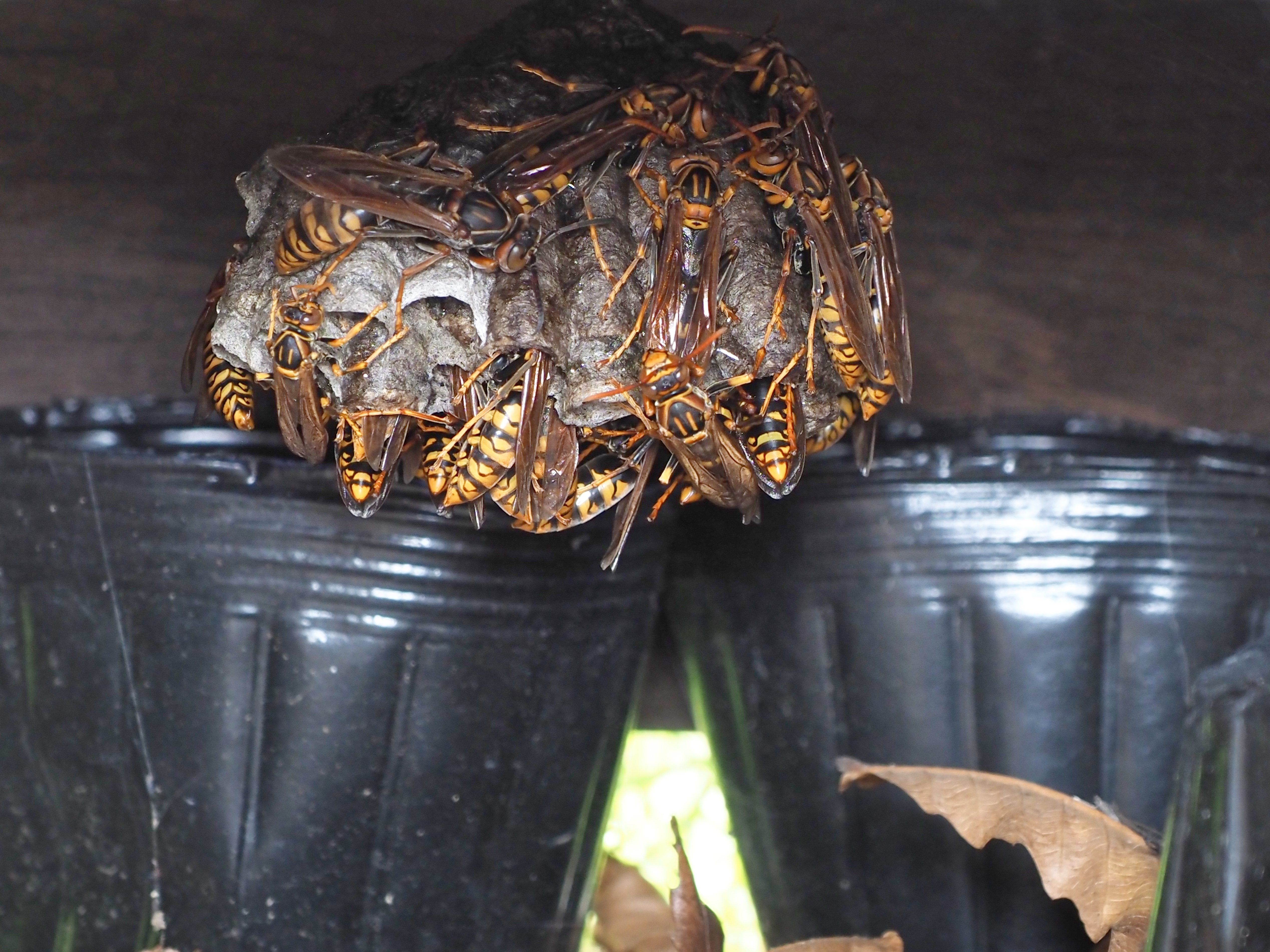
Open paper wasp nest with visible cells
Siding & eaves

Wall voids and overhangs

  • Wasps slipping into a gap in siding or soffit
  • Buzzing or chewing noise behind a wall
  • Paper wasp combs under eaves and railings

Yellow jackets build inside wall cavities, attics and soffits through gaps no bigger than a pencil. Paper wasps build open, umbrella-shaped combs under eaves, deck rails and grill covers.

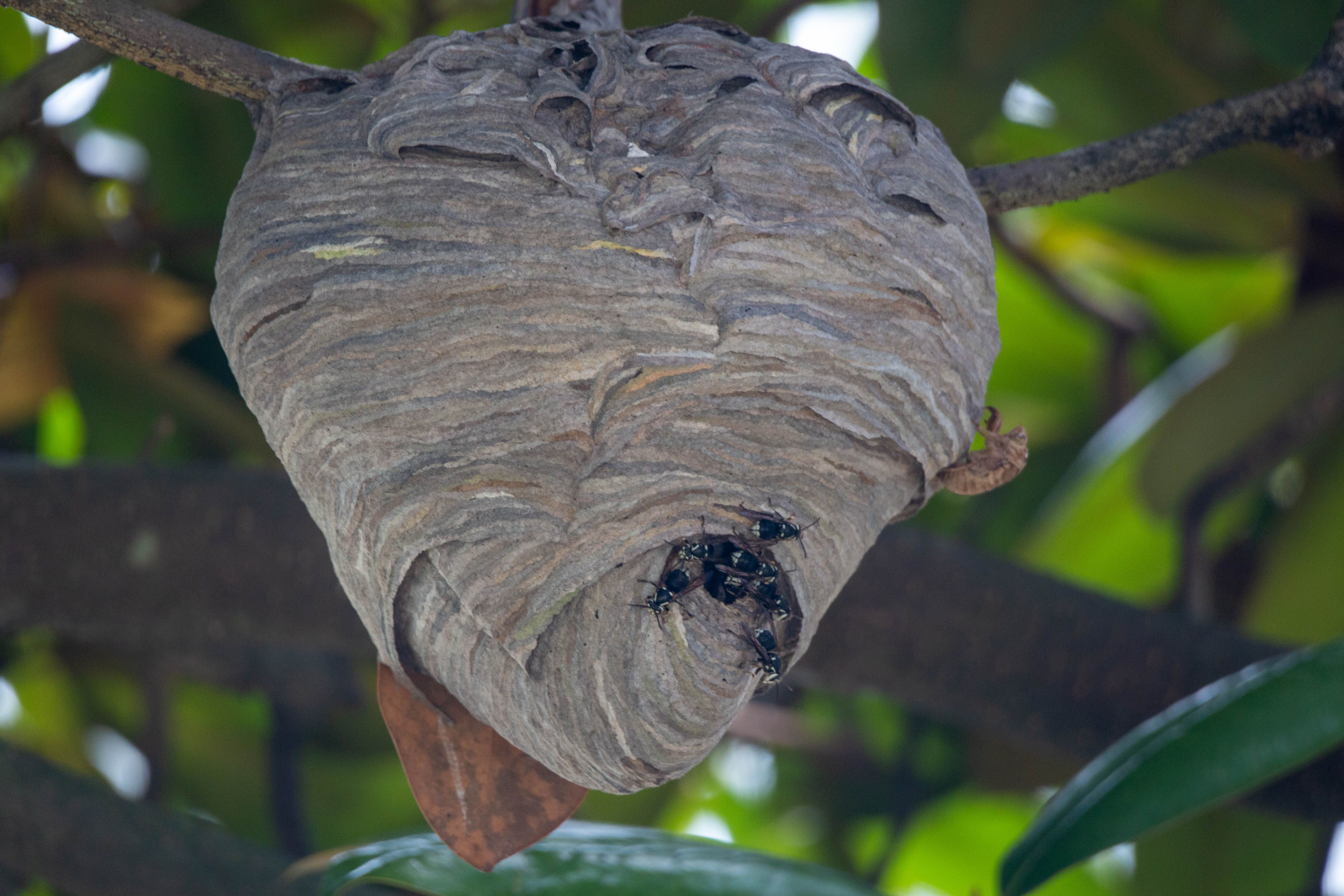
Large gray hornet nest on a tree branch
Up high

Hornet nests in trees

  • Gray, papery ball-shaped nest
  • Hanging from branches, shrubs or eaves
  • Black-and-white wasps guarding it

Bald-faced hornets (actually a kind of yellow jacket) build big gray paper nests in trees and shrubs. They defend them hard, so a nest near a path, pool or play set is worth removing.

Yellow jacket, paper wasp, hornet or honey bee?

InsectWhat it looks likeNestHow defensive
Yellow jacketSmall, shiny, bright yellow and black, fast flyerHidden: underground, in walls or atticsVery; will sting repeatedly, especially late summer
Paper waspSlim, long dangling legs, brown or yellow markingsOpen comb, no outer cover, under eaves and railsModerate unless the nest is bumped
Bald-faced hornetBlack with white face markings, largerGray paper ball in trees, shrubs or on the houseVery; guards the nest
Honey beeFuzzy, golden-brown, slower flyerWax comb in a hollow tree or wall; swarms hang in clustersUsually calm away from the hive

Yellow jackets are often mistaken for bees. If you're not sure, a photo of a few insects at the entrance settles it.

Why yellow jackets get worse in late summer

A yellow jacket nest starts in spring with a single queen. By August and September, a healthy colony can have thousands of workers, and that's when most Parsippany calls come in.

  • The colony is at full size. More workers means more traffic past doors, decks and pool areas.
  • Their diet changes. Early in the season workers hunt insects for the larvae. Later they go after sugar: soda cans, fruit, juice boxes, garbage cans and the hummingbird feeder.
  • They get more defensive. Late-season nests react fast to vibration, which is why mowing over a ground nest so often ends in multiple stings.

Colonies die off after hard frosts, and only new queens overwinter, usually in protected spots like loose bark or wall cavities. Old nests aren't reused. But if a nest is in a spot where people walk, play or work, waiting for frost isn't a realistic plan in August.

What not to do with a yellow jacket nest

🚫

Don't plug the hole

Sealing an entrance in siding or a wall can send yellow jackets through the inside wall, into a bedroom or kitchen. Leave it open until the nest is treated.

πŸ’§

Don't flood or burn it

Pouring water, gasoline or fire into a ground nest is dangerous and usually fails. The nest is deeper than it looks and the survivors come out angry.

🧴

Don't rely on a can from the store

A spray at the entrance often kills the guards but not the colony inside, and it puts you face to face with the nest.

πŸͺœ

Don't climb to reach it

Being stung on a ladder is how a nuisance becomes an injury. Leave high nests for someone with the gear.

If someone stung has trouble breathing, swelling of the face or throat, or feels faint, call 911. Many people get stung more than once with yellow jackets, so take any reaction seriously.

How we remove yellow jacket and wasp nests

1

Walk the property

We confirm the insect and look for every nest. Yards with one ground nest often have another along the fence or under a shrub.

2

Treat at the entrance

Ground and wall nests are treated right where the workers go in, so the material is carried through the nest to the queen and larvae. Hanging nests are treated and taken down when it's safe.

3

Give it time

Returning workers contact the treatment over the next day or so. Keep people and pets away from the entrance meanwhile.

4

Follow up if needed

If you still see steady traffic after a few days, let us know. Afterward we can point out gaps in siding or soffits to seal so the next spring's queens don't move in.

Commercial properties, office parks and apartment complexes can call too. See commercial pest control.

Why Parsippany properties see so many nests

Parsippany-Troy Hills is a big township with a lot of green space mixed into its neighborhoods. Around Lake Parsippany, Lake Hiawatha and Rainbow Lakes, and along the wooded edges of many streets, the landscape gives yellow jackets and wasps plenty to work with:

  • Wooded lots and stone walls full of old rodent burrows that yellow jackets take over.
  • Decks, docks and screened porches with lots of sheltered corners for paper wasps.
  • Older split-levels and colonials whose siding and soffits have gaps that open into wall cavities.
  • Outdoor eating at pools, patios and picnic areas, which draws foragers once the season turns to sugar.

The office parks and shopping centers along Route 46, Route 10 and the I-80 and I-287 corridors deal with nests in signs, light fixtures, dumpster areas and entry overhangs, where a lot of people walk past every day.

Honey bees are handled differently

Honey bees are not pests to wipe out. If what you have is a honey bee swarm hanging from a branch or a colony living in a wall or tree, we work with a local beekeeper so the bees are relocated, not exterminated.

A swarm in spring is usually calm; the bees are resting while scouts look for a new home, and it may move on by itself within a day or so. A colony that has already built comb inside a wall is a bigger job, because the comb and honey have to come out or they'll attract other insects and can stain the wall.

Ground bees, carpenter bees and bumble bees are other look-alikes. Send us a photo and we'll tell you what you have. For ground-nesting bees, see our page on ground bee removal.

Scheduling a visit in Parsippany

We serve Parsippany and the rest of Morris County from our base in Garfield. Because it's outside our core Bergen, Passaic, Essex and Hudson area, we schedule these visits ahead. Same-day service is sometimes possible, especially early in the day, but we can't promise it.

  • Text a photo and tell us where the nest is (ground, wall, tree, eave) and how high up.
  • Mark a ground nest with a stick or flag from a safe distance so it's easy to find.
  • Keep kids and pets away from the area until we've treated it.
  • Let us know about anyone in the house with a known sting allergy.

Call or text 973-510-2585 for a free quote.

Get a Free Yellow Jacket Removal Quote in Parsippany

Send a photo of the nest or the insects and tell us where it is. We'll identify it and let you know when we can come out.

Why Parsippany calls us for stinging insects

  • Yellow jackets coming out of the lawn
  • Buzzing inside a wall or ceiling
  • Hornet nest near the pool or play set
  • Wasps around a business entrance
  • Not sure if they're bees or wasps
πŸ“ž Call 973-510-2585

Request Service

πŸ”’ Your info stays private Β· Hablamos espaΓ±ol.

What's bugging you? - Step 1 of 3

Yellow Jacket & Wasp Questions from Parsippany

Are yellow jackets bees or wasps?

Yellow jackets are wasps. They're smooth and shiny with bright yellow markings, while honey bees are fuzzy and golden-brown.

Why are yellow jackets so aggressive in September?

By late summer the colony is at full size and workers switch to hunting sugar, so there are more of them around people and they defend the nest hard.

Should I plug the hole yellow jackets are using in my siding?

No. Blocking the entrance can push them into the house through the inside wall. Have the nest treated first, then seal the gap.

Can I pour water or gas into a ground nest?

Please don't. It's dangerous, it rarely reaches the whole nest, and the survivors come out ready to sting.

Will the nest die on its own?

Yes, colonies die off after hard frosts and old nests aren't reused. If the nest is where people walk or play, waiting usually isn't practical.

How fast does nest treatment work?

Most activity drops within a day or two as returning workers contact the treatment. Large or hidden nests sometimes need a follow-up.

Do you remove honey bees?

We don't exterminate honey bees. We work with a local beekeeper so swarms and colonies are relocated.

Do you come to Parsippany for wasp removal?

Yes, we serve Parsippany-Troy Hills. Visits are scheduled ahead, and same-day is sometimes possible.

Do you take down the nest?

Hanging nests are usually removed once treated. Ground and wall nests are treated in place, since digging or opening walls isn't needed to kill the colony.

Are you licensed?

Yes. Silver Bullet Pest Control holds NJ License 90568B and has over 15 years of experience.

ΒΏAtienden avispas en Parsippany en espaΓ±ol?

SΓ­, hablamos espaΓ±ol. MΓ‘ndenos una foto del nido al 973-510-2585.

Wasp and bee pages in Morris County and nearby

More stinging insect pages for towns around Parsippany.

Updated November 2026 by the Silver Bullet Pest Control team, Garfield, NJ β€’ NJ License 90568B

Scroll to Top