
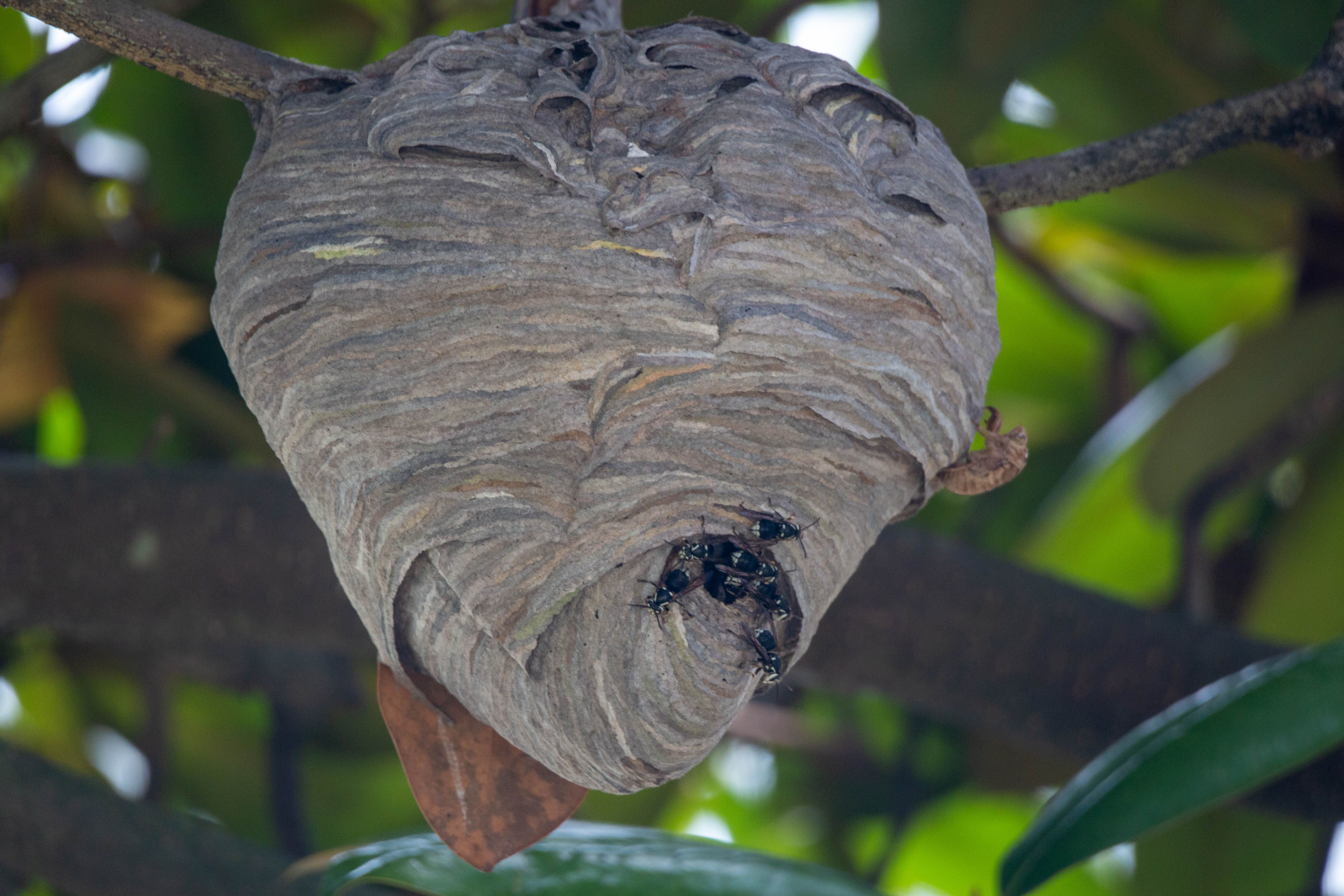
Bald-faced hornets
- Black with white face markings
- Enclosed gray paper nest, one entrance
- In trees, shrubs and under eaves
The most aggressive of the three around the nest. Never try to bag, knock down or spray one of these from a ladder.
 Silver Bullet Pest Control
A gray paper nest the size of a football in the maple out front, black-and-white wasps chasing you off the lawn, or a nest under the eave of the garage? Silver Bullet Pest Control serves Chatham with bald-faced hornet, wasp and yellow jacket nest removal for homes and businesses.
4.9 stars on Google • NJ License 90568B • 15+ years • Free quotes • Hablamos español
Text a photo of the nest — from a safe distance — to 973-510-2585. We'll tell you what it is.
Silver Bullet Pest Control removes bald-faced hornet nests in Chatham, along with paper wasp and yellow jacket nests. A licensed technician in protective gear treats the nest, takes it down once the hornets are dead, and checks the property for other nests. Chatham visits are scheduled ahead, and same-day is sometimes possible. NJ License 90568B, 4.9 stars on Google, free quotes. Call or text 973-510-2585.
Despite the name, the bald-faced hornet isn't a true hornet. It's a large relative of the yellow jacket — black, with white or ivory markings on the face and the tip of the body. It's one of the most defensive stinging insects in New Jersey.
What makes them a problem:
On the plus side, bald-faced hornets eat a lot of flies and other insects. A nest far out in the woods, away from where anyone walks, can often be left alone. A nest by a front walk, a driveway or a play area is a different story.
We remove all three in Chatham. Here's how to tell them apart:
The most aggressive of the three around the nest. Never try to bag, knock down or spray one of these from a ladder.
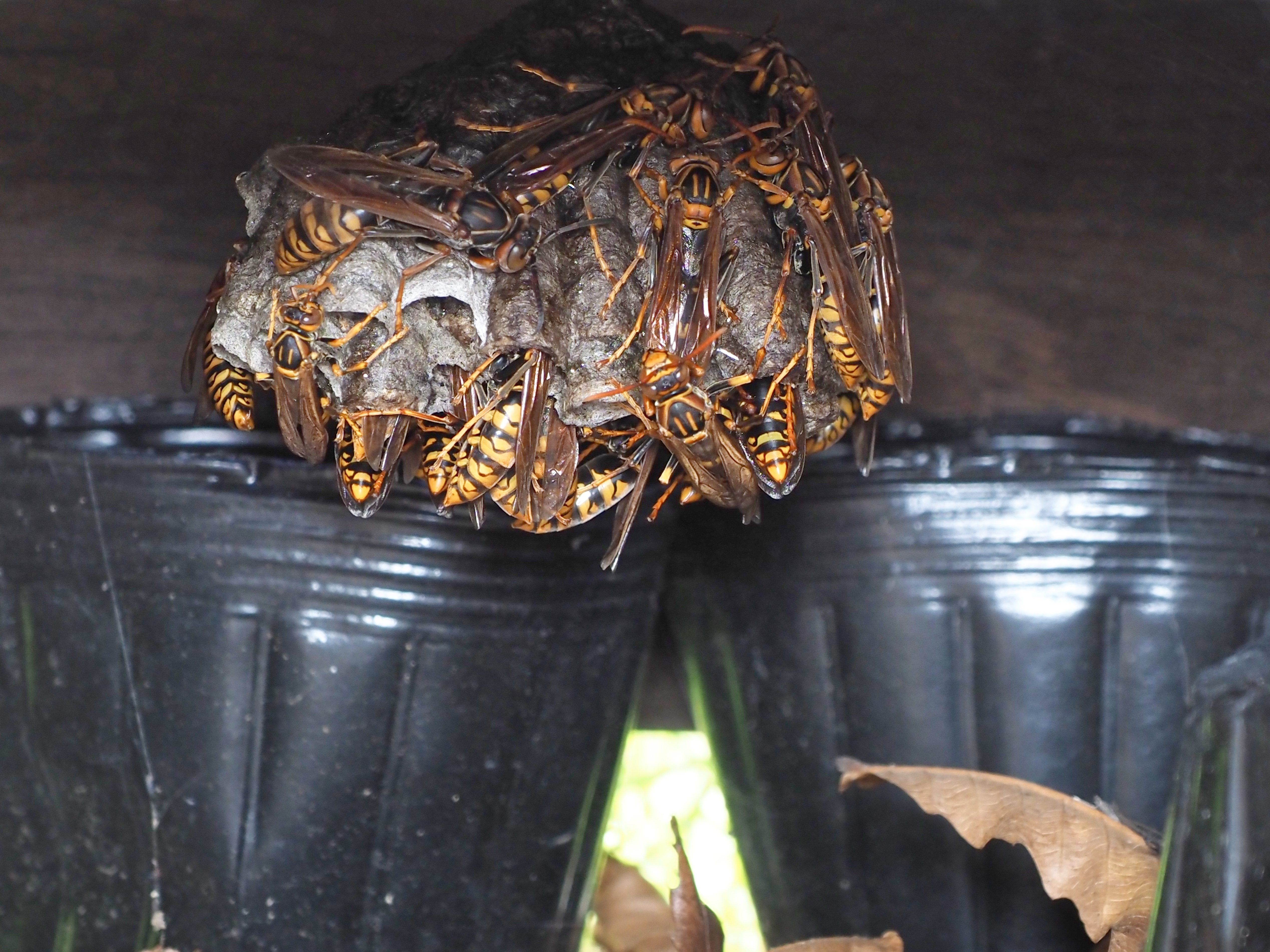
Paper wasps are calmer, but nests by doors, decks and porches lead to stings. They often rebuild in the same sheltered spots each year.

Yellow jackets cause the most stings, because the nest is hidden until someone steps on it or mows over it. Never plug the hole of a wall nest.
Location decides how urgent the job is and how we reach it:
| Nest location | Risk | How we handle it |
|---|---|---|
| High in a tree, away from paths | Low to moderate — may be left alone | We'll tell you honestly if it's safe to wait for winter |
| High in a tree over a driveway, walk or patio | High — people pass under it daily | Treat from a safe distance with extended equipment, then remove |
| In a shrub or hedge at waist height | Very high — easy to bump or trim into | Treat carefully and remove; hold off on trimming until it's done |
| Under an eave, porch roof or gutter | High if near a door or window | Treat and take the nest down once inactive |
| On a shed, play set or fence | High for kids and pets | Treat, remove, and check the rest of the yard |
| In the ground or inside a wall | Yellow jackets, not hornets — very high | Treat the nest through the entrance; seal only after it's dead |
Text us a photo plus a wider shot showing where the nest sits relative to the house. It saves time on the visit.
A single queen that survived the winter starts a small nest, about the size of a golf ball. Rarely noticed, but easy to deal with.
Workers hatch and the nest grows quickly, adding layers of gray paper. Activity around the entrance picks up.
The nest is at its biggest and the colony is most defensive. Leaves fall and nests suddenly appear in trees.
The workers and old queen die. New queens leave to overwinter elsewhere. The empty nest isn't reused.
An empty nest in December can be left to fall apart. If you see activity on a warm day, assume it's still live and call.
Most stings we hear about happen when someone tries to deal with a nest themselves. Please don't:
Allergic to stings? Keep well away from the nest and don't try anything yourself. Swelling of the face or throat, trouble breathing, or dizziness after a sting is a medical emergency — call 911.
From your photo we confirm it's hornets (or wasps, or yellow jackets) and how high and exposed the nest is. Chatham visits are scheduled ahead; same-day is sometimes possible.
A licensed technician in protective gear treats the nest, often from a distance with extended equipment for high nests.
Once the hornets are dead, we remove nests we can safely reach and bag them, so returning workers don't cluster around it.
We look around the house, garage and yard for more nests. Late in the season it's common to find a second one.
For gaps where wasps keep returning, see entry point sealing.
Chatham is a town of tree-lined streets, older homes, well-kept yards and a busy Main Street. Those features shape where we find nests:
Chatham borders the Passaic River and there's a lot of open, wooded land nearby, so stinging insects have plenty of natural habitat close to homes. That's normal — we only step in when a nest is where people are.
Quotes are free. These are the main factors:
| Factor | Simpler job | Bigger job |
|---|---|---|
| Height | Low shrub or eave you can reach from the ground | High in a tree or at a second- or third-floor eave |
| Size | Early-season nest | Late-summer nest the size of a basketball |
| Insect | Paper wasps | Bald-faced hornets or yellow jackets in a wall |
| Number | One nest | Several nests on the property |
| Access | Open yard | Over a roof, a pool, a fence or a steep slope |
Call or text 973-510-2585 with a photo and where the nest is.
Send a photo of the nest and tell us where it is and how high. Let us know if anyone in the home is allergic.
🔒 Your info stays private · Hablamos español.
They're very defensive around the nest and can sting repeatedly, so a nest near people is a real risk. Away from people they're mostly beneficial predators.
If it's high, away from walks and play areas, often yes — the colony dies off in winter. If people pass under it, have it removed.
No. The colony dies in winter and new queens start fresh nests elsewhere in spring.
In late fall it may still have live hornets on warm days. Watch the entrance from a distance; if there's traffic, treat it as active and call.
Bald-faced hornets are black and white and build paper nests above ground; yellow jackets are yellow and black and usually nest in the ground or walls.
Chatham visits are scheduled ahead of time, and same-day is sometimes possible. Call or text 973-510-2585.
Yes, when we can safely reach it. Nests inside walls or the ground are treated in place.
We don't recommend it. Ladders, darkness and an angry colony are a bad mix, and store sprays often don't penetrate the nest.
Yes. We schedule around business hours and check entrances, rooflines and outdoor seating areas.
Yes. Silver Bullet Pest Control holds NJ License 90568B and has over 15 years of experience.
Sí. Hablamos español. Mande una foto del nido por texto al 973-510-2585.
We also serve these towns for stinging insects:
Updated November 2026 by the Silver Bullet Pest Control team, Garfield, NJ • NJ License 90568B