Silver Bullet Pest Control logoSilver Bullet Pest Control
Bees, Wasps & Hornets Β· Summit Β· Union County

Bee, Wasp & Hornet Removal in Summit, NJ

A cloud of bees hanging from a branch, yellow jackets diving into a hole by the patio, or a gray paper nest high in a tree? Silver Bullet Pest Control serves Summit homeowners and businesses with bee and wasp removal. We tell you exactly which insect you have first, because a honey bee swarm and a yellow jacket nest need completely different answers.

4.9 stars on Google β€’ NJ License 90568B β€’ 15+ years β€’ Honey bees relocated, not killed β€’ Hablamos espaΓ±ol

Not sure if it's bees or wasps? Text a photo from a safe distance to 973-510-2585 and we'll tell you.

  • βœ“ Same-day appointments often available
  • βœ“ Licensed & insured in NJ
  • βœ“ Homes & businesses
  • βœ“ English & EspaΓ±ol

Who removes bees and wasps in Summit, NJ?

Silver Bullet Pest Control removes wasp, hornet and yellow jacket nests in Summit and arranges honey bee relocation with a beekeeper instead of killing them. A licensed technician identifies the insect, treats and removes stinging-insect nests, and checks the rest of the property. Summit visits are scheduled ahead, and same-day is sometimes possible. NJ License 90568B, 4.9 stars on Google, free quotes. Call or text 973-510-2585.

Bee or wasp? A quick ID chart

Most calls we get about "bees" in Summit turn out to be yellow jackets. Here's how to tell what you're looking at:

InsectWhat it looks likeWhere it nestsWhat we usually do
Honey beeFuzzy, golden-brown, about half an inchSwarms hang in a ball on a branch; colonies live in hollow trees, walls or soffitsRelocate with a local beekeeper
Bumble beeLarge, round, very fuzzy, black and yellowSmall nests in the ground, under decks or in old rodent holesOften left alone; we treat only if it's beside a door or play area
Ground (mining) beesSmall, dark, solitary; many little dirt mounds in bare lawnIndividual burrows in dry, thin grass in early springUsually harmless and gone in a few weeks; we'll tell you honestly
Carpenter beeBig, shiny black rear end, hovers at eaves and railingsRound holes drilled into bare woodAsk us β€” we'll look at the wood and explain options
Yellow jacketSmooth, shiny, bright yellow and black, quick flierIn the ground, wall voids, stone walls, atticsTreat the nest; seal the opening once it's dead
Paper waspSlim, long legs hanging in flightOpen umbrella comb under eaves, railings, grillsTreat and remove the nest
Bald-faced hornetBlack with white face markingsGray paper ball in trees, shrubs or under eavesTreat and remove the nest

Can't get close enough to tell? Don't try. A zoomed-in phone photo from 15 or 20 feet away is plenty β€” text it to 973-510-2585.

Honey bees: relocated, not exterminated

Honey bees are pollinators and they matter. When you call us about honey bees in Summit, we work with a beekeeper so the swarm or colony is relocated, not killed.

There are two very different honey bee situations:

  • A swarm. In late spring an established colony splits, and thousands of bees leave with the old queen. They land in a hanging cluster on a branch, fence or mailbox while scouts look for a new home. A swarm looks frightening but is usually calm, because the bees have no comb or young to defend. It may move on within a day or two β€” or it may move into your house. Call early.
  • An established colony. If bees are flying in and out of the same gap in a wall, soffit, chimney area or hollow tree day after day, they've moved in and are building comb. This takes more planning, because the comb has to be reached. Leftover comb and honey inside a wall can attract other insects and cause stains, so it's not something to seal up and forget.

Please don't spray honey bees, and don't block the hole they're using. Blocking a colony in a wall can send bees into the house. Text us a photo and tell us how long they've been there.

The stinging insects we remove in Summit

These three cause almost all the stings we hear about:

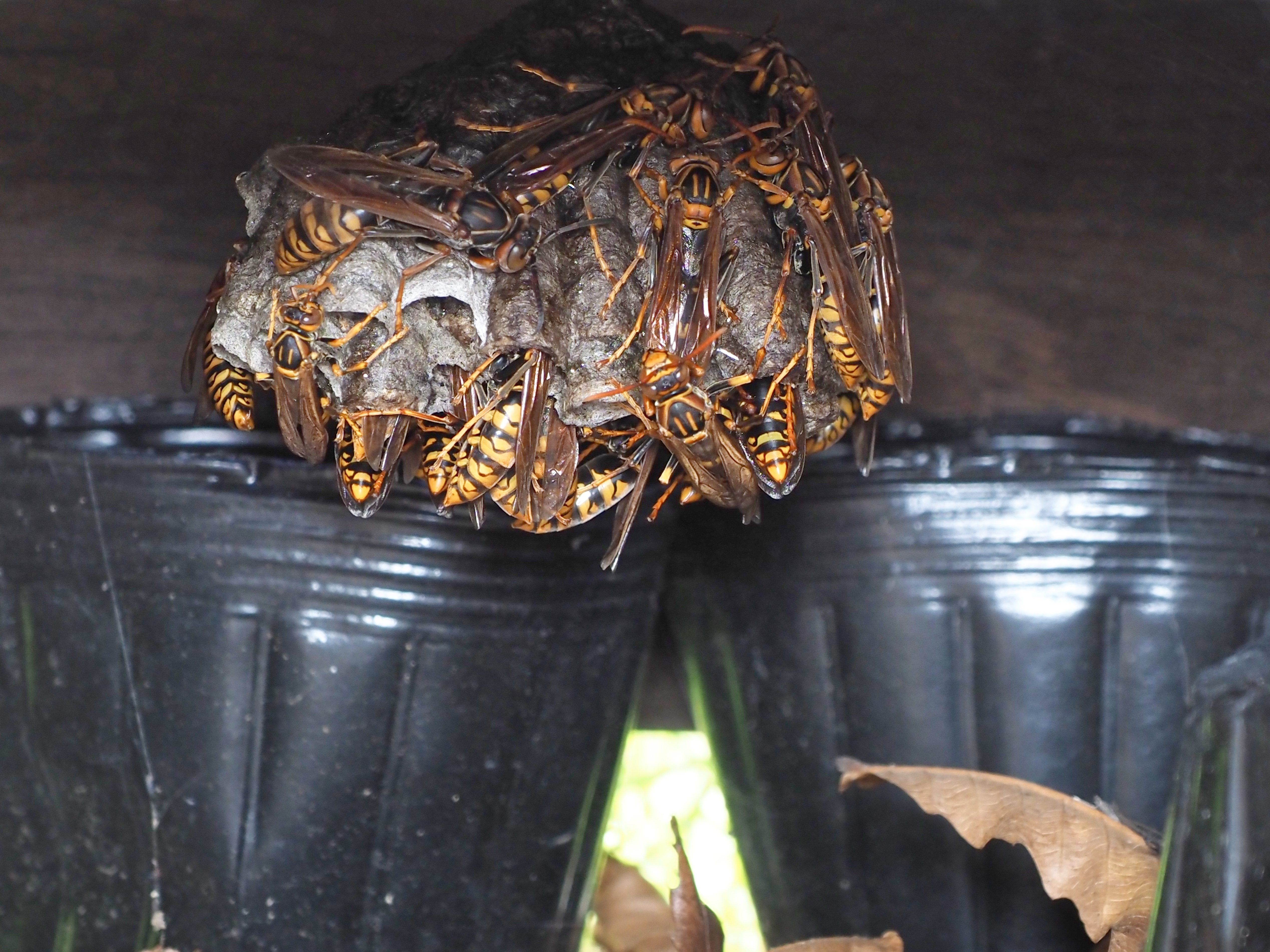
Paper wasp nest with open cells under a ledge
Most common

Paper wasps

  • Open, umbrella-shaped comb
  • Under eaves, porch ceilings, railings and grill lids
  • Slim wasps with legs dangling in flight

Paper wasps are the nest you find when you open a patio umbrella or lift a grill cover. They're less aggressive than yellow jackets but will sting to defend the comb, and a nest beside a door gets people stung all summer.

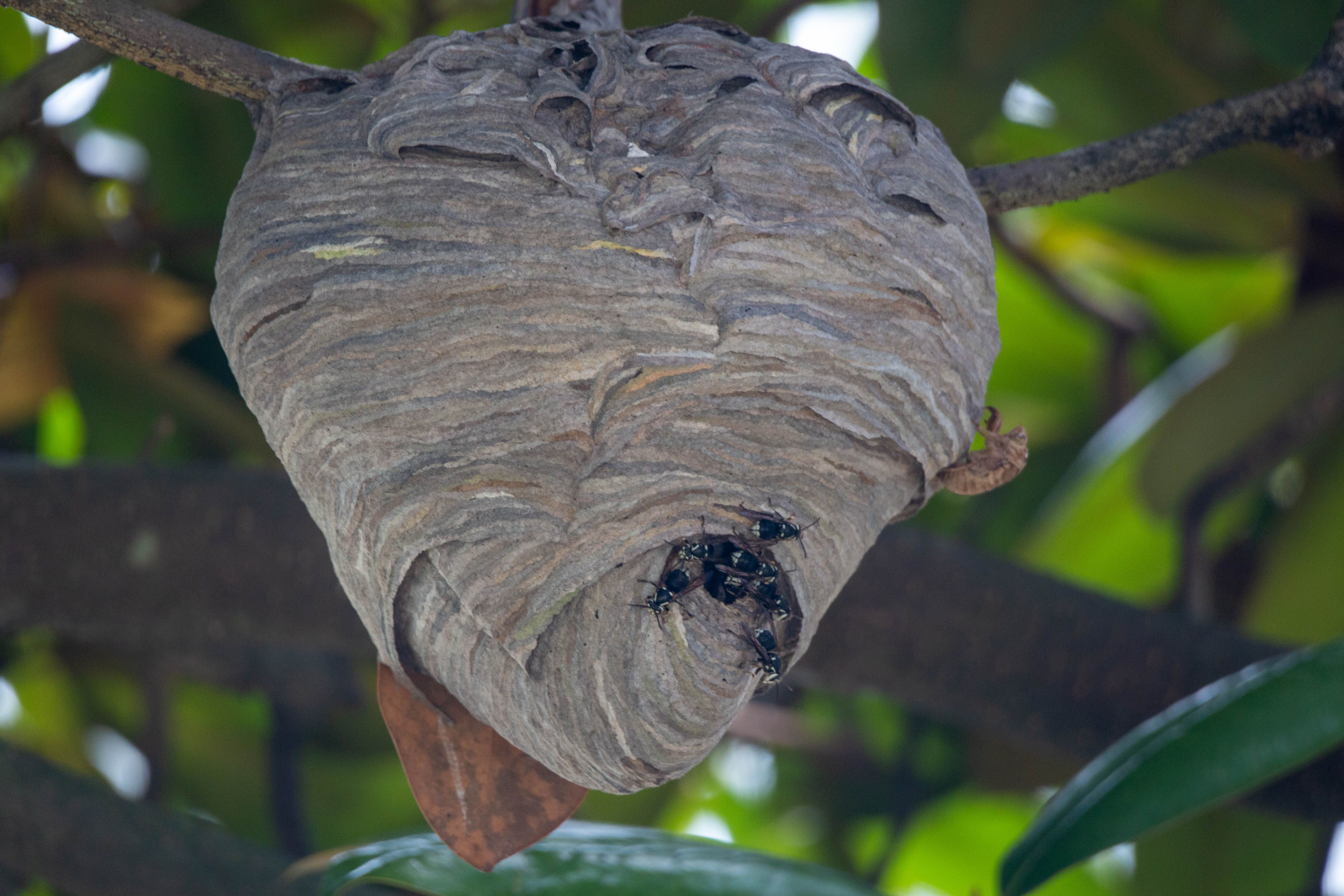
Gray paper hornet nest attached to a tree branch
Big nests

Bald-faced hornets

  • Gray paper ball, football-size or bigger
  • High in trees, in hedges or under eaves
  • Black-and-white wasps defending it hard

These nests are often hidden by leaves until fall. They're defended very aggressively, especially if a hedge trimmer or mower vibrates the branch they're on. Don't try to knock one down.

Cracked masonry with gaps where insects can get into a wall
Most stings

Yellow jackets

  • Steady traffic in and out of one hole
  • In lawns, stone walls, wall voids and attics
  • Swarm out when the ground is disturbed

Yellow jackets build hidden nests, so people find them by stepping on them or mowing over them. By late summer a nest can hold thousands of workers, and they sting repeatedly. A wall nest can chew through into a room.

Where bees and wasps show up on Summit properties

Summit is a hilly town with a lot of older, larger homes, big shade trees, established gardens and detached garages. That's a lot of protected corners for nests, and a lot of flowers for bees.

  • Deep eaves, porch ceilings and dormers on older houses β€” classic paper wasp territory, often on a second or third floor.
  • Stone walls, terraced beds and retaining walls on sloped lots. Yellow jackets love the gaps between stones.
  • Mature trees and tall hedges. Bald-faced hornet nests can hang 20 feet up and go unnoticed until the leaves drop.
  • Hollow trees and old chimneys, where honey bee colonies sometimes settle in for years.
  • Pool houses, sheds and play sets that sit unused for part of the year.
  • Restaurants and shops downtown with outdoor seating, where yellow jackets go after food and drinks in late summer.

The wooded Watchung Reservation is close by, and gardens like the Reeves-Reed Arboretum show how much this area loves its plants. Bees on your flowers are a good sign, not a reason to call. We only step in when a nest is where people live, work or play.

Found a nest or a swarm? Do this first

1

Keep people and pets back

Walk away calmly β€” don't swat. Keep kids and dogs inside or away from that side of the house until it's handled.

2

Know the warning signs

Swelling of the lips, face or throat, trouble breathing, or dizziness after a sting is a medical emergency. Call 911.

3

Leave the nest alone

No spraying, no hose, no fire, and no plugging the hole. All of these tend to make stinging insects angrier or push them indoors.

4

Send us a photo

Text a picture and the location β€” front porch, back lawn, second-floor eave β€” to 973-510-2585. We'll identify it and schedule a visit.

How a bee or wasp visit works

1

We identify it first

From your photo, then on site. Honey bees go to the beekeeper route; wasps, hornets and yellow jackets get treated.

2

We schedule the visit

Summit is outside our core North Jersey area, so visits are set up ahead of time. Same-day is sometimes possible β€” ask when you call.

3

Treat and remove

A licensed technician in protective gear treats the nest, including nests inside walls or in the ground, and takes down exposed nests once they're inactive.

4

Check the whole property

Many yards have more than one nest. We walk the house, garage and yard and point out gaps where wasps keep coming back.

Want openings closed after the nest is gone? See entry point sealing.

Bees and wasps through the year in Summit

SeasonBeesWasps, hornets & yellow jackets
Early springGround bees dig in thin lawns; bumble bee queens look for nest spotsOverwintered queens start tiny nests β€” easiest time to remove them
Late springHoney bee swarm seasonPaper wasp combs appear under eaves and railings
SummerColonies grow; bees work the gardensNests grow fast; yellow jacket nests fill wall voids and ground holes
Late summer & fallHoney bee colonies stay activeYellow jackets and hornets peak and get aggressive around food; hornet nests show when leaves fall
WinterHoney bee colonies cluster inside and surviveWorkers die off; old nests aren't reused, so it's a good time to seal gaps

Seeing activity in winter on a warm day? It's often a honey bee colony in a wall. Text us a photo.

What affects the price of bee and wasp removal

Quotes are free. These are the things that change the job:

πŸͺœ

Height and reach

A nest at eye level under a porch rail is quick. A nest up at a third-floor eave or high in a tree takes more equipment and time.

🧱

Hidden or exposed

Exposed paper nests are simpler than yellow jackets inside a wall, a stone wall or under a deck.

🐝

Which insect

Honey bee relocation is planned with a beekeeper and depends on whether it's a swarm or a colony with comb.

πŸ”

How many nests

Two or three nests around one property are common in late summer. We find them all on one visit when we can.

Call or text 973-510-2585 with a photo and where the nest is, and we'll give you a straight answer.

Get a Free Bee & Wasp Quote in Summit

Send a photo, tell us where the nest or swarm is, and let us know if anyone in the home is allergic to stings.

Why Summit calls us for bees and wasps

  • A honey bee swarm that should be saved, not sprayed
  • Yellow jackets in the lawn, a stone wall or a wall void
  • A hornet nest high in a tree
  • Wasps under the eaves of an older home
  • Someone in the house is allergic
πŸ“ž Call 973-510-2585

Request Service

πŸ”’ Your info stays private Β· Hablamos espaΓ±ol.

What's bugging you? - Step 1 of 3

Bee & Wasp Questions from Summit

Do you kill honey bees?

No. We work with a beekeeper so honey bee swarms and colonies are relocated, not exterminated. Wasps, hornets and yellow jackets are treated.

How do I know if I have bees or yellow jackets?

Honey bees are fuzzy and golden-brown; yellow jackets are smooth, shiny and bright yellow. Text a photo to 973-510-2585 and we'll tell you.

There's a big ball of bees on a tree branch. Is that dangerous?

That's usually a honey bee swarm resting while it looks for a new home, and swarms are normally calm. Keep people back and call us early, before they move into a wall.

How soon can you come to Summit?

We schedule Summit visits ahead of time, and same-day is sometimes possible. Call or text and tell us how close the nest is to a door.

Can I just pour something down a yellow jacket hole?

We don't recommend it. Many people get stung doing it, and a partial kill often leaves an angry nest or pushes them into the house.

Do you remove the nest or just spray it?

We treat the nest, then remove exposed nests once activity stops. Nests deep in walls or the ground are treated where they are.

What about bees drilling holes in my deck or trim?

Those are likely carpenter bees. Ask us β€” we'll look at the wood and explain your options.

Will wasps come back to the same spot next year?

Old nests aren't reused, but a protected eave or gap can attract a new queen. Sealing the gap is the long-term fix.

Do you handle bees and wasps at businesses?

Yes. We work with restaurants, shops and offices and schedule around your hours. See our commercial pest control page.

Are you licensed?

Yes. Silver Bullet Pest Control holds NJ License 90568B and has over 15 years of experience.

ΒΏHablan espaΓ±ol?

SΓ­. Hablamos espaΓ±ol. Llame o mande un texto con una foto al 973-510-2585.

Bee and wasp removal around Summit

We also serve these towns for stinging insects:

Updated November 2026 by the Silver Bullet Pest Control team, Garfield, NJ β€’ NJ License 90568B

Scroll to Top