
 Silver Bullet Pest Control
HOA Pest Control Service & Inspections in NJ
Mice moving from one townhouse to the next, yellow jackets by the pool, raccoons in the trash corral? Silver Bullet Pest Control inspects and services homeowners associations, condo communities and townhouse developments in Bergen, Passaic, Essex and Hudson counties, with one plan for the common areas and clear answers for residents.
4.9 stars on Google • NJ License 90568B • 15+ years • Based in Garfield • Hablamos español
Managing a community? Call or text 973-510-2585 to set up a walk-through of your common areas and buildings.
- ✓ Same-day appointments often available
- ✓ Licensed & insured in NJ
- ✓ Homes & businesses
- ✓ English & Español
What does HOA pest control include?
HOA pest control is a recurring service plan for a homeowners or condo association that covers the shared buildings and grounds: an initial inspection of common areas and building exteriors, scheduled treatments for rodents and insects, wildlife and termite checks, and a clear process for unit complaints. Silver Bullet Pest Control sets this up for North Jersey communities and reports what we find to the board or manager. Call or text 973-510-2585 for a free quote.
What an HOA pest control inspection covers
The first step is a walk-through of the whole community, not one unit. That's where we find the reason the same complaints keep coming back.
Building exteriors
Foundations, siding gaps, utility and dryer vent penetrations, garage doors, roof lines, soffits and gable vents on every building or row.
Trash and recycling areas
Dumpster pads, trash corrals and compactor rooms, the top spot for rats, roaches, flies and raccoons in most communities.
Amenities
Clubhouse, gym, pool deck and pool house, mailrooms, laundry rooms and maintenance sheds.
Grounds
Mulch beds, retaining walls, wood borders, playgrounds, drainage areas and any standing water that breeds mosquitoes.
We walk the property with the manager or a board member when possible, note what we find building by building, and recommend a plan. If you need findings in a specific written format for the board or your insurance, ask us when you book so we can talk through what we can provide.
Where pests start in condo and townhouse communities
Attached housing behaves differently from a street of single-family homes. When units share walls, attics, crawl spaces or a garage level, a problem in one home is rarely just in one home.
- Shared attics and roof lines. In many townhouse rows, squirrels, raccoons and bats that get in at one end can travel above several units.
- Utility chases and pipe runs. Mice and roaches follow plumbing and wiring between units, especially in garden-style condo buildings.
- Trash enclosures. One overflowing corral can feed rats for the whole community. Lids, pad cleanliness and pickup schedules matter as much as treatment.
- Landscaping. Thick mulch against siding holds moisture for termites and ants, and ground-nesting yellow jackets love sunny slopes and lawn edges.
- Detention basins and drains. Standing water in clogged drains, basins and tarps breeds mosquitoes all summer.
Treating one complaint at a time, unit by unit, tends to chase pests around the property. A community-wide plan stops the cycle.
HOA pest control responsibility: association or unit owner?
This is the question boards ask most. The real answer is in your governing documents, but this is how it often breaks down in general:
| Area or problem | Often handled by | Why |
|---|---|---|
| Common grounds, trash areas, clubhouse, pool | Association | Shared property maintained with common funds |
| Building exterior, roof, foundation, siding | Association (in many condo associations) | Exterior is often a common element; townhouse HOAs vary |
| Wildlife in shared attics or roof lines | Usually the association | Entry points are on the exterior or shared structure |
| Pests inside a single unit | Often the unit owner | Interior is usually the owner's responsibility |
| Pests spreading between units | Shared or case by case | The source may be in a common wall, chase or another unit |
| Termites in a building | Depends on the documents | Structure may be common or owner-maintained |
This table is general information, not legal advice. Master deeds, bylaws and rules differ from one community to the next, and they can change. Boards should check their documents and talk with the association's attorney or manager. Our landlord and tenant guide covers rental units in general terms.
Recurring HOA pest control service plans
Initial inspection
A full walk-through of buildings and grounds, with a list of problem areas and recommended fixes.
Clean-out treatment
We treat active problems first: rodents at trash areas, roaches in utility rooms, nests on buildings.
Scheduled service
Regular visits on a set schedule (monthly or quarterly, depending on the property) for exterior and common-area treatment and monitoring.
Seasonal add-ons
Stinging insects in summer, mosquitoes from spring to fall, and wildlife checks when animals look for winter shelter.
Regular recurring service comes with our 100% satisfaction guarantee. Compare schedules on our monthly and quarterly pest control page.
The pests HOA boards call us about most

Mice and rats
- Burrows by trash pads or retaining walls
- Droppings in garages and storage rooms
- Complaints from several units at once
We treat, then seal the gaps they use. Exclusion on attached buildings is the long-term fix.
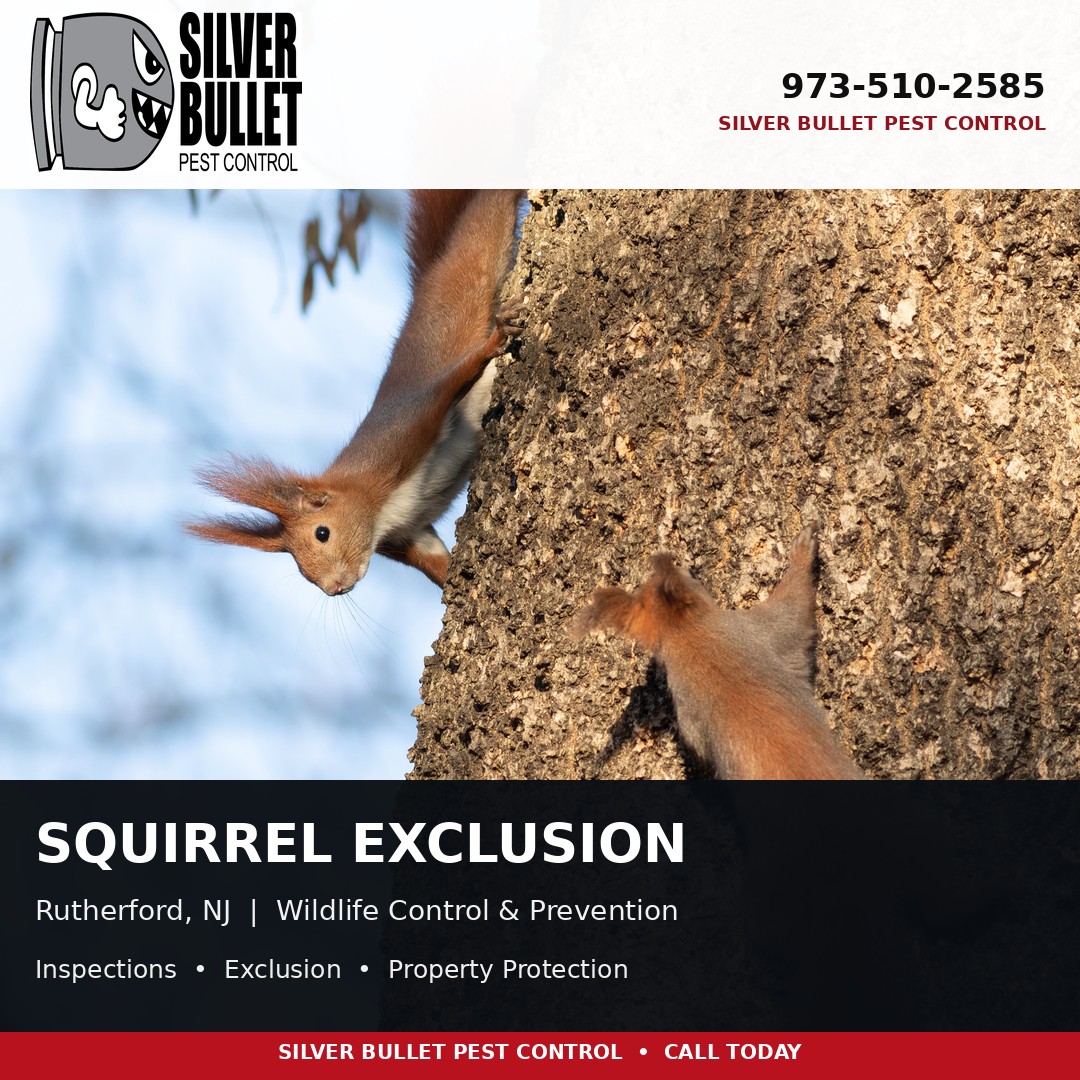
Squirrels, raccoons and bats
- Noise above units at dawn or night
- Chewed soffits or fascia
- Droppings in shared attic space
Licensed by NJ Fish and Wildlife. Animals out first, then entry points sealed and repaired.
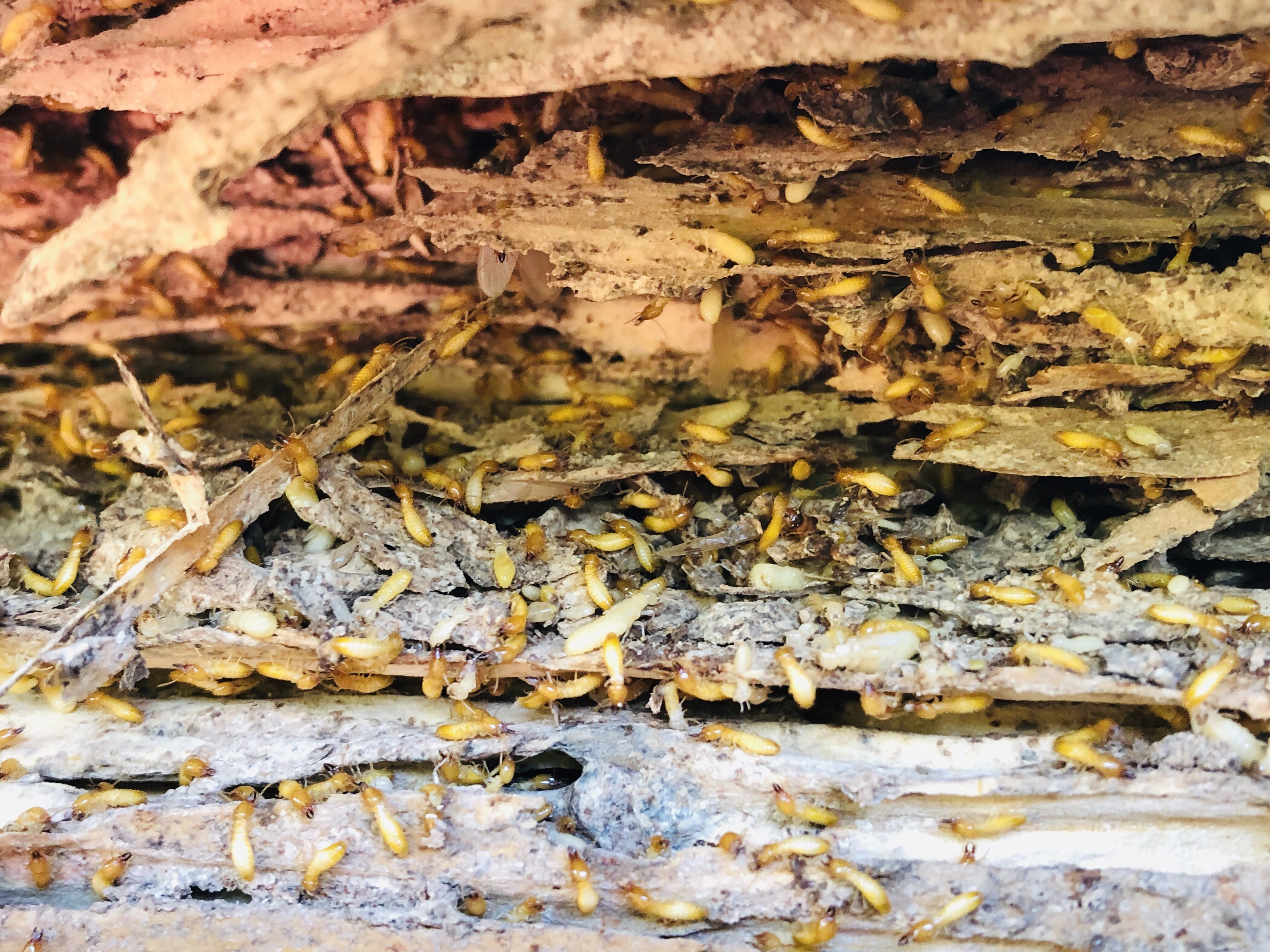
Termites in attached buildings
- Mud tubes on foundations
- Swarmers in spring
- Soft wood near grade
We inspect every building and can repair termite damage ourselves after treatment: sill plates, joists, beams and framing.
Handling resident complaints the smart way
A resident reports mice. Two weeks later the neighbor does. Then someone at the far end of the row. Each call on its own looks small, but together they're a pattern.
We help boards and managers set up a simple routine:
- One point of contact. Residents report to the manager, and the manager sends us the unit, the pest and a photo.
- Quick ID. Many complaints are solved by a photo: a stink bug or a harmless beetle doesn't need a visit.
- Check the neighbors. For rodents, roaches and bed bugs in attached buildings, we look at the units around the complaint, not just the one that called.
- Fix the source. If the cause is on the exterior or in a common area, it gets handled under the association's plan.
- Close the loop. The manager hears what we found and what was done, so the board can answer residents.
We explain things to residents in English or Spanish, which helps in mixed communities.
How to choose an HOA pest control company
Before signing a contract, boards should ask any company these questions:
| Ask about | What a good answer sounds like |
|---|---|
| NJ licensing | A current NJ pesticide applicator business license (ours is 90568B) and wildlife licensing if animals are involved |
| Insurance | Certificates provided to the association or manager on request |
| The inspection | A walk of every building and the grounds, not a quick look at the clubhouse |
| Unit complaints | A clear process for resident calls and who pays for what |
| Exclusion and repairs | Whether they seal entry points and fix damage, or only spray |
| Communication | Findings shared with the board in plain language, in English or Spanish if needed |
For larger properties also see our property management pest control and apartment building pages.
More pages for associations and managers
Get a free quote for your community
Tell us the community, how many buildings or units, and the problems residents report. We'll set up a walk-through.
Why associations work with us
- One plan for buildings, grounds and resident complaints
- Wildlife, termites and insects handled by one licensed company
- Recurring service backed by a 100% satisfaction guarantee
- 4.9 stars on Google, over 15 years of experience
- Hablamos español with residents and staff
Request Service
🔒 Your info stays private · Hablamos español.
HOA pest control questions
Is the HOA responsible for pest control?
Often for common areas and building exteriors, but it depends on your community's governing documents. In many associations the board handles shared grounds, trash areas, amenities and the building shell, while unit owners handle their own interiors. Check your master deed and bylaws, and ask the association's manager or attorney for your specific case.
How often should an HOA have pest control service?
Most communities do well with a regular schedule, often monthly or quarterly, plus seasonal add-ons. Properties with busy trash areas, restaurants nearby or a history of rodents usually need more frequent visits. After the first inspection we recommend a schedule that fits the size, layout and problem history of your property.
What happens during an HOA pest inspection?
A licensed technician walks every building exterior and the common areas: foundations, roof lines, vents, trash enclosures, clubhouse, pool and grounds. We look for entry points, signs of rodents, insects, termites and wildlife, then explain what we found and recommend a plan to the board or property manager.
Who pays when mice move between townhouses?
It depends on where the problem starts and what your documents say. If mice come in through the exterior or a shared wall, many associations handle it; if it's inside one unit, the owner may be responsible. Inspecting the neighboring units helps show where the source really is.
Can you handle wildlife in a shared attic?
Yes. Silver Bullet Pest Control is licensed by the NJ Division of Fish and Wildlife. We find where squirrels, raccoons or bats are getting in, get the animals out, then seal and repair the openings. For bats, sealing is timed to the seasons New Jersey allows to protect young bats.
Do you inspect HOA buildings for termites?
Yes. Termite inspections of each building are a smart part of any community plan, especially with mulch beds and wood near the foundation. If we find termites, we treat and can repair the damaged wood ourselves after treatment, including sill plates, joists, beams and framing.
Is pest control around the pool and playground safe?
Yes, when it's done right. We choose products and placement with children, pets and residents in mind, treat around rather than on play surfaces, and schedule visits to avoid busy pool hours when needed. Let us know about any residents with health concerns so we can plan around them.
Can residents call you directly?
We usually suggest residents report problems to the manager or board first so everything is tracked and paid for correctly. Owners can also hire us for problems inside their own unit. We're happy to explain findings to residents directly, in English or Spanish, when the association wants that.
Do you serve condo associations outside your core counties?
Our core area is Bergen, Passaic, Essex and Hudson counties, with our base in Garfield. We also serve communities in Morris and Union counties; those visits are scheduled ahead, which works well for a recurring plan. Call to talk about your property's location.
¿Atienden asociaciones de condominios en español?
Sí. Hablamos español con la administración, la junta y los residentes. Inspeccionamos las áreas comunes y los edificios, y explicamos el plan con claridad. Llame o mande un texto al 973-510-2585 para una cotización gratis.
HOA pest control across North Jersey
We service associations and condo communities in Bergen, Passaic, Essex and Hudson counties.
Our service area
Bergen County
973-510-2585- Allendale
- Bergenfield
- Bogota
- Carlstadt
- Cliffside Park
- Closter
- Cresskill
- Demarest
- Dumont
- East Rutherford
- Edgewater
- Elmwood Park
- Emerson
- Englewood
- Englewood Cliffs
- Fair Lawn
- Fairview
- Fort Lee
- Franklin Lakes
- Garfield
- Glen Rock
- Hackensack
- Harrington Park
- Hasbrouck Heights
- Haworth
- Hillsdale
- Ho-Ho-Kus
- Leonia
- Little Ferry
- Lodi
- Lyndhurst
- Mahwah
- Maywood
- Midland Park
- Montvale
- Moonachie
- New Milford
- North Arlington
- Northvale
- Norwood
- Oakland
- Old Tappan
- Oradell
- Palisades Park
- Paramus
- Park Ridge
- Ramsey
- Ridgefield
- Ridgefield Park
- Ridgewood
- River Edge
- River Vale
- Rochelle Park
- Rutherford
- Saddle Brook
- Saddle River
- South Hackensack
- Teaneck
- Tenafly
- Teterboro
- Upper Saddle River
- Waldwick
- Wallington
- Washington Township
- Westwood
- Woodcliff Lake
- Wood-Ridge
- Wyckoff
Passaic County
973-510-2585- Bloomingdale
- Clifton
- Haledon
- Hawthorne
- Little Falls
- North Haledon
- Passaic
- Paterson
- Pompton Lakes
- Prospect Park
- Ringwood
- Totowa
- Wanaque
- Wayne
- West Milford
- Woodland Park
Essex County
973-510-2585- Belleville
- Bloomfield
- Caldwell
- Cedar Grove
- East Orange
- Essex Fells
- Fairfield
- Glen Ridge
- Irvington
- Livingston
- Maplewood
- Millburn
- Montclair
- Newark
- North Caldwell
- Nutley
- Orange
- Roseland
- Short Hills
- South Orange
- Verona
- West Caldwell
- West Orange
Hudson County
973-510-2585Union County
973-510-2585- Berkeley Heights
- Clark
- Cranford
- Elizabeth
- Fanwood
- Garwood
- Hillside
- Kenilworth
- Linden
- Mountainside
- New Providence
- Plainfield
- Rahway
- Roselle
- Roselle Park
- Scotch Plains
- Springfield
- Summit
- Union
- Westfield
Morris County
973-510-2585- Boonton
- Butler
- Cedar Knolls
- Chatham
- Denville
- Dover
- East Hanover
- Florham Park
- Hanover
- Kinnelon
- Lincoln Park
- Madison
- Mendham
- Montville
- Morris Plains
- Morristown
- Mountain Lakes
- Parsippany
- Pequannock
- Randolph
- Riverdale
- Rockaway
- Roxbury
- Whippany
Updated November 2026 by the Silver Bullet Pest Control team, Garfield, NJ • NJ License 90568B