How to Keep Mice Out of Your House
Mice don't break in — they walk in through gaps you didn't know were there. This guide from our rodent team shows where mice get into New Jersey homes, what actually keeps them out, what doesn't, and when it's time to call a professional.
Featured on Telemundo 47 • EPA Pesticide Safety Certified • 5-Star Google Rated • NJ License 90568B
Send us a photo of a gap or droppings and we'll tell you what we see.
- ✓ Same-day appointments often available
- ✓ Licensed & insured in NJ
- ✓ Homes & businesses
- ✓ English & Español
What's the best way to keep mice out of a house?
Trap the mice that are already inside, then close every opening bigger than about a quarter inch with materials mice can't chew: steel mesh, hardware cloth, metal flashing and sealant. Store food in sealed containers and keep clutter off basement and garage floors. If mice keep coming back, a professional exclusion job finds the gaps you can't see. Silver Bullet Pest Control does this for homes across Bergen, Passaic and Essex counties — call 973-510-2585.
Why mice get into New Jersey homes
House mice want three things: warmth, food and a safe place to nest. In New Jersey, that pushes them indoors every fall, usually from September to November, when nights start getting cold. Once inside, a pair of mice can turn into a family in a few weeks.
Older homes, two-family houses and homes with attached garages see the most mice because they have more openings: old pipe holes, settled foundations, worn door sweeps and spots where additions meet the original house. A mouse can squeeze through a gap about the size of a dime — roughly a quarter inch.
That's why traps alone rarely solve it. Traps remove the mice you have. Sealing is what stops the next ones.
Where mice get in: the spots we find most
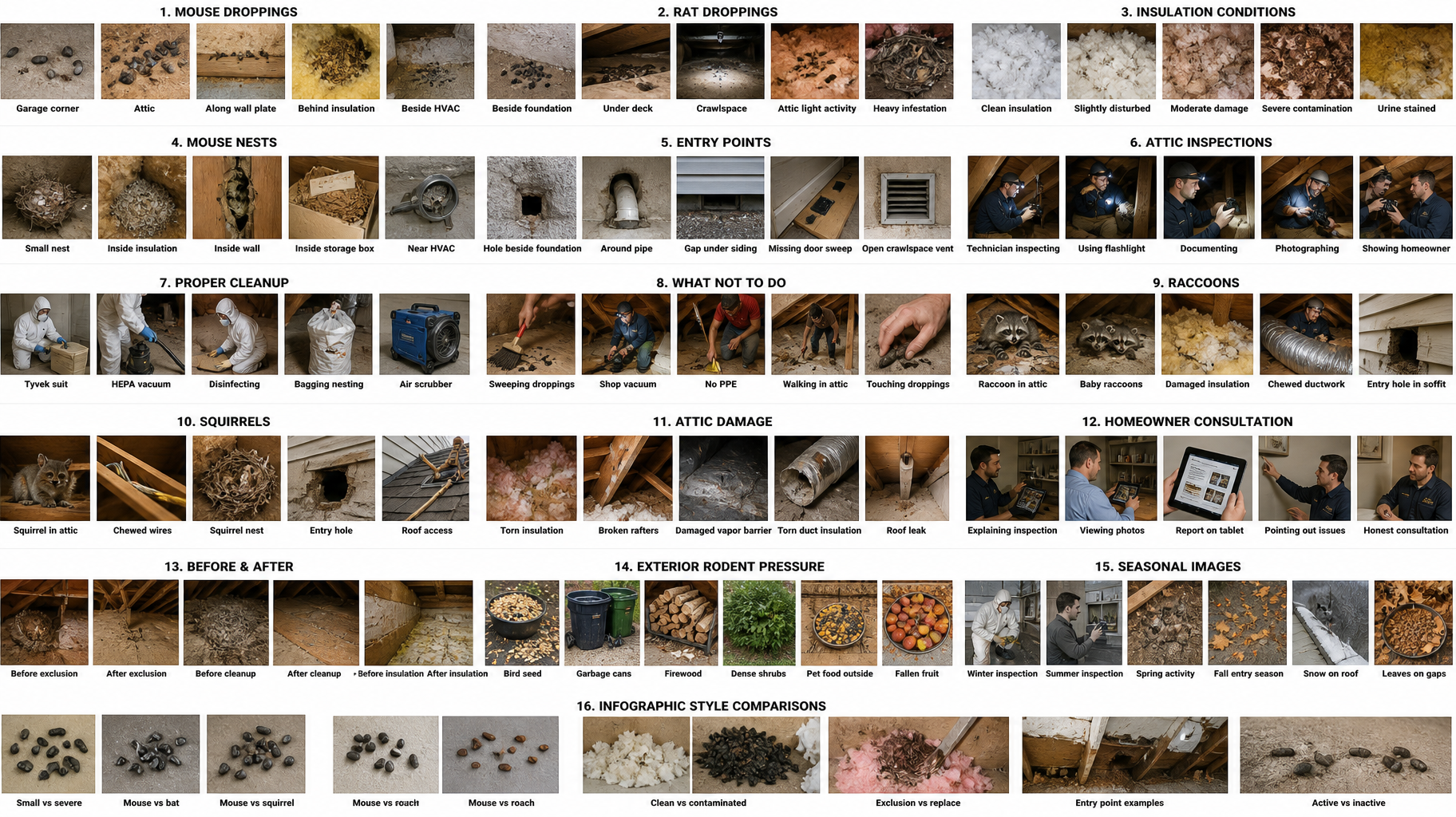
These are real photos from our inspections.

Pipes, gas lines and AC lines
- The hole around the pipe is bigger than the pipe
- Cracked or missing sealant
- Droppings right next to the line
This is the #1 spot we seal. Look where every pipe, wire and line goes through an outside wall.

Garage doors and corners
- Daylight under the door corners
- Chewed or flattened bottom seal
- Droppings along the walls and in boxes
Garages are warm, full of storage, and often connect straight into the house.
Dryer vents, exhaust vents and basement windows
- Vent flaps that don't close
- Missing screens
- Gaps around window frames
Vents need a rodent guard that still lets air out — never block a dryer vent completely.
Room-by-room check: where to look for gaps
| Area | What to check | What to look for |
|---|---|---|
| Outside walls | Every place a pipe, cable, gas line or AC line goes in | Gaps around the line, old foam, droppings or grease marks |
| Foundation | Where siding meets the foundation, corners, behind shrubs | Cracks, gaps, holes, chewed weather barrier |
| Garage | Door corners, bottom seal, the wall shared with the house | Daylight, chewed rubber, droppings in boxes |
| Basement | Windows, sill plate, pipe and drain holes, crawlspace openings | Gaps along the top of the foundation wall, droppings |
| Kitchen | Under the sink, behind the stove and fridge, dishwasher | Holes where pipes come through, droppings in cabinets |
| Attic & roofline | Soffits, gable vents, where the roof meets the walls | Gaps, chewed insulation, nesting material |
| Doors | Bottom of every exterior door | Daylight under the door, worn sweep |
Found something you're not sure about? Text a photo to 973-510-2585.
How to seal your house against mice, step by step
Trap first
Seal too early and you trap mice inside your walls. Set snap traps along walls where you see droppings and check them daily until you catch nothing for a week.
Walk the outside
Go around the whole house with a flashlight, low and high. Mark every gap bigger than a pencil.
Stuff with steel
Pack small holes tightly with copper or stainless steel mesh. Mice can't chew through it.
Cover and seal
Cover bigger openings with hardware cloth (1/4 inch) or metal flashing, then seal the edges with exterior sealant.
Fix doors and vents
Add door sweeps, replace worn garage door seals, and put rodent guards on vents.
Remove what draws them
Store food, pet food and bird seed in sealed containers. Keep garbage closed and clutter off the floor.
Check again in a month
Look for new droppings. If you still see signs, there's a gap you missed — that's when a pro helps most.
What to seal with: materials that work and ones that don't
| Material | Keeps mice out? | Best use |
|---|---|---|
| Steel or copper mesh | Yes | Stuffing small holes around pipes and wires |
| Hardware cloth (1/4 inch) | Yes | Covering larger openings, vents and crawlspace gaps |
| Metal flashing / sheet metal | Yes | Gaps at the foundation, under siding, garage corners |
| Exterior sealant or mortar | Yes, over mesh | Finishing the edges after mesh or metal |
| Spray foam alone | No | Mice chew through it — only use it over steel mesh |
| Caulk alone | No | Fine for tiny cracks, not for real openings |
| Steel wool alone | Not for long | Rusts and falls apart outdoors — use stainless or copper mesh |
What doesn't keep mice out
- Peppermint oil, dryer sheets and mothballs may bother a mouse for a moment, but they don't stop an infestation, and mothballs aren't safe to use loose in living spaces.
- Ultrasonic plug-ins don't seal anything. Mice get used to the sound, and it doesn't pass through walls or furniture.
- Spray foam alone is soft enough for mice to chew through in a night.
- Poison alone can leave mice dying inside walls, which causes odor, and it doesn't stop new mice coming in.
- A cat may catch a few mice, but it won't close the gap they came in through.
If you keep seeing mice every fall, there's an opening that hasn't been found yet.
Signs you already have mice
- Droppings — small, dark, about the size of a grain of rice, along walls, in cabinets and drawers.
- Scratching or running in walls or ceilings at night.
- Chewed food boxes, wires or insulation.
- Nesting material — shredded paper, fabric or insulation in quiet corners.
- A musty smell in closed spaces like cabinets or the basement.
Not sure if it's mice or rats? Rat droppings are much bigger, about the size of a raisin. See does one mouse mean more?
When to call a professional
- You see droppings in more than one room, or fresh droppings after you cleaned.
- You hear scratching in walls or ceilings at night.
- Mice come back every fall even after trapping.
- The openings are hard to reach — the roofline, soffits, behind siding or inside a finished basement.
- You have kids or pets and want traps and baits placed safely.
Our rodent service includes the inspection, removal, sealing with steel and a follow-up visit, and we tell you the price before any work starts. See our rat & mouse exterminator page.
More help with mice and rats
Want us to find the gaps for you?
Tell us what you're seeing. We'll get back to you fast, usually the same business day.
Why people call us
- Mice back every fall
- Droppings in the garage or kitchen
- Scratching in the walls
- Gaps they can't reach themselves
- Kids or pets in the home
Request Service
🔒 Your info stays private · Hablamos español.
Keeping Mice Out: FAQ
How small a hole can a mouse fit through?
About the size of a dime, roughly a quarter inch. If a pencil fits through it, a mouse can too.
What is the best material to keep mice out?
Stainless steel or copper mesh, hardware cloth and metal flashing, finished with sealant. Foam, rubber and plastic alone get chewed through.
Should I seal holes before the mice are gone?
No. Trap the mice inside first, then seal. Sealing first can trap them inside your walls or attic.
Why do mice come back every fall?
When nights get cold, mice look for warmth. If an opening is still there, new mice find it every year.
Who can seal my house from mice?
A pest control company that does rodent exclusion. Silver Bullet seals homes across Bergen, Passaic and Essex counties with steel. Call 973-510-2585.
Do peppermint oil or ultrasonic devices keep mice away?
Not for long. They don't close the gaps, and mice get used to them.
What are signs of a bad mouse infestation?
Droppings in several rooms, fresh droppings after cleaning, chewed food boxes, nesting material, a musty smell and scratching at night.
Does one mouse mean more?
Usually, yes. Mice live in groups and breed fast, so seeing one often means there are others nearby.
Can mice climb walls?
Yes. Mice climb brick, stucco and rough siding, so check up high — rooflines, soffits and vents — not just the ground.
How long does it take to get rid of mice?
Most homes see a big drop in the first week or two once trapping and sealing are done. Bigger problems can take a few visits.
¿Cómo evito que entren ratones a mi casa?
Atrape los ratones que ya están adentro y luego selle cada hueco con malla de acero y sellador. Llame o mande texto al 973-510-2585.
Rodent help near you
Based in Garfield, we serve these towns and the rest of Bergen, Passaic and Essex counties.
Updated October 2026 by the Silver Bullet Pest Control team, Garfield, NJ • NJ License 90568B