
Cranford, Union County · Bee Exterminator

Bee, Wasp & Hornet Removal in Cranford, NJ

Bees pouring out of a soffit, buzzing inside a wall, carpenter bee holes in the porch trim? Silver Bullet Pest Control identifies the bee first, relocates honey bees whenever it’s safe and practical, and treats stinging insect nests that can’t be relocated. When honey bees are inside a wall or roof cavity, the bees and comb usually have to come out through an opened section, so we plan and quote that work in advance. We seal the entry point only after the bees are gone.

Featured on Telemundo 47 • NJ Licensed & Insured • 5-Star Google Rated • NJ License 90568B

Not sure what kind of bee it is? Text us a photo from a safe distance and we’ll tell you.

  • ✓ Same-day appointments often available
  • ✓ Licensed & insured in NJ
  • ✓ Homes & businesses
  • ✓ English & Español

Who exterminates bees in Cranford, NJ?

Call Silver Bullet Pest Control at 973-510-2585, a licensed New Jersey exterminator (NJ License 90568B) that removes and exterminates bees in Cranford and the rest of Union County. We identify the species and find the nest first, relocate honey bees whenever it’s safe and practical, treat nests that can’t be safely relocated, and seal the entry point only after activity has stopped. A colony inside a wall, soffit or roof cavity usually means opening that section to remove the bees and comb, which we plan and quote in advance. Same-day visits are often available, and we speak Spanish.

Why Cranford homes get bees

Cranford is full of older homes with wood trim, porches and roof returns, on streets lined with mature trees, with green space along the Rahway River. That gives bees plenty of places to nest. Here are three common problems.

Bee pollinating yellow broom flowers
Honey bees

Honey bees in walls, soffits and trees

  • Heavy bee traffic in and out of one gap
  • Buzzing inside a wall, ceiling or attic
  • A swarm clustered on a branch or fence

Honey bees are important pollinators, so we relocate them whenever it’s safe and practical. When a colony is inside a wall or roof cavity, that section usually has to be opened to take out the bees and comb, so we plan and quote it in advance. The opening is sealed only once the bees are gone, never with a live colony inside.
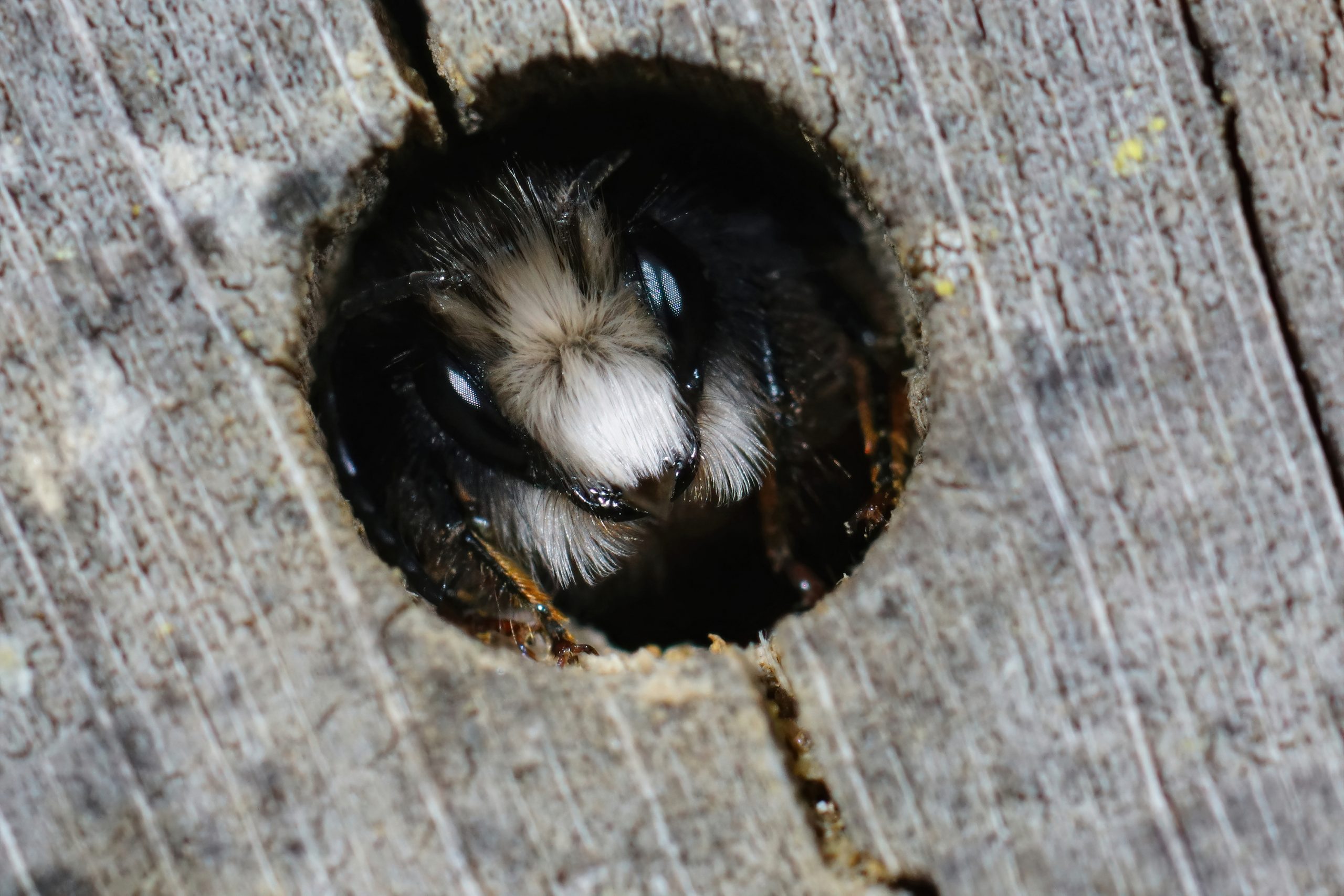
Close-up of a mason bee
Wood-nesting & solitary bees

Carpenter bees in porches and trim

  • Round, clean holes in fascia, trim or railings
  • Sawdust-like debris under the wood
  • Woodpecker damage around old holes

Carpenter bees rarely sting, but they tunnel into the same wood year after year and can weaken fascia, trim, railings and decking. We treat the holes, then check the wood for spots that need sealing or repair.

Paper wasp nest
Wasps, yellow jackets & hornets

Stinging insects near doors and patios

  • A nest under the eaves, porch ceiling or deck
  • Insects going in and out of a hole in the lawn
  • Stinging insects near a door, patio or play set

Not every “bee” is a bee. Wasps, yellow jackets and hornets are more defensive and may need faster treatment when the nest is close to people. We confirm what it is before anything is treated.

Relocate or treat? It depends on the bee and the nest

Bee removal and bee extermination aren’t the same service. The right choice depends on the species, where the nest is, how big the colony is and how likely stings are.

Insect How to spot it Usual nest spot What we usually do
Honey bee Fuzzy, golden-brown, rounder body Wall voids, tree hollows, swarms on branches Live capture and relocation when safe and practical; a colony in a wall usually means opening the wall, planned and quoted in advance
Carpenter bee Large, shiny black abdomen Holes drilled in fascia, trim, decks, railings Treat the holes, then seal them once activity stops
Bumble bee Large, very fuzzy, black and yellow Ground cavities, insulation voids, under decks Depends on where the nest is
Mason and solitary bees Small, often metallic or dark Small holes in wood, soil or masonry Usually low risk; we identify them before doing anything
Wasps, yellow jackets, hornets Smooth, slimmer, bright markings Eaves, porch ceilings, shrubs, holes in the ground Treatment or nest removal, faster when near people

Seeing a swarm? Keep a safe distance and don’t spray it. Swarms are often calm, but they should still be handled by a professional.

After a sting: if the person has trouble breathing, swelling of the face or throat, or feels dizzy, call 911.

What a bee exterminator visit looks like

1

Inspect

We identify the species, find the nest and judge the risk to the people around it.

2

Plan & price

We choose live removal or targeted treatment and tell you the price before any work starts.

3

Remove or treat

We complete a safe extraction or a precise treatment, with clear re-entry guidance for kids and pets.

4

Prevent

Once activity has stopped, we seal the entry point and point out anything that attracts bees, so the same spot isn’t used again.

Bees in Cranford, season by season

🌱

Spring

Nest building ramps up. Honey bee swarms look for new homes and carpenter bees start drilling into trim.

☀️

Summer

Activity peaks. Colonies in walls and soffits grow and bee traffic gets easy to spot.

🍂

Fall

Stinging insects get more defensive as food runs low. Nests near doors and patios need attention.

❄️

Winter

Outside activity drops off. A good time to repair carpenter bee damage and seal empty gaps. Honey bee colonies stay alive inside walls all winter, so never seal an opening they’re using.

Schools, businesses & property managers

Restaurants, schools, apartment complexes, stores and parks get the same bee problems as homes, with more people walking by. We respond fast when employees, tenants or customers are affected. See commercial pest control in Cranford.

What does a bee exterminator cost in Cranford?

It depends on the species, where the nest is, how high it is, how easy it is to reach, the size of the colony and whether wall, soffit or wood damage is involved. We give a free quote and tell you the price before any work starts. See bee removal cost.

Get a free bee removal quote in Cranford

Tell us what you’re seeing and where. We’ll get back to you fast, usually the same business day.

Call us for

  • Bees going into a wall or soffit
  • Buzzing inside a wall or ceiling
  • A honey bee swarm
  • Carpenter bee holes in trim or a deck
  • Bumble bees or ground bees in the yard
  • Stinging insects near a door or patio

📞 Call 973-510-2585

Request Service

🔒 Your info stays private · Hablamos español.

What's bugging you? - Step 1 of 3

Bee Exterminator Questions in Cranford

Can you save the honey bees?

We relocate honey bees whenever it's safe and practical. If the colony is inside a wall or roof cavity, that section usually has to be opened to remove the bees and comb. We plan and quote that in advance and seal the opening only after the bees are gone.

How do I know if it's honey bees or wasps?

Honey bees are fuzzy and golden-brown with a rounder body. Wasps are smoother, slimmer and often more brightly striped. Text us a photo and we'll tell you, or we confirm it during the inspection.

Is bee treatment safe for kids and pets?

We use careful methods around children and pets, and we give you clear re-entry guidance for the treated area.

Will the bees come back after treatment?

Sealing the entry point once activity has stopped greatly lowers the chance of bees using the same spot again.

How long does bee removal take?

Most jobs are done in a single visit. Larger or hard-to-reach colonies can take longer.

¿Hablan español?

Sí, hablamos español. Quitamos y eliminamos abejas en Cranford y todo el condado de Union. Llame o mande texto al 973-510-2585.

Serving Cranford & nearby towns

Bee removal in Cranford and the Union County towns around it.

CranfordWestfieldGarwoodKenilworthRoselle ParkRoselleLindenClarkUnionSpringfieldScotch PlainsElizabeth

Updated October 2026 by the Silver Bullet Pest Control team, Garfield, NJ • NJ License 90568B

Scroll to Top