
 Silver Bullet Pest Control
mice vs rats
Found droppings in the garage, heard scratching in the ceiling, or caught a glimpse of a tail behind the stove? Here's how to tell mice from rats by size, droppings, sounds and behavior — and why knowing which one you have changes how you get rid of it.
4.9 stars on Google • NJ License 90568B • 15+ years • Based in Garfield, NJ • Hablamos español
Text a photo of the droppings next to a coin to 973-510-2585 and we'll tell you if it's mice or rats.
- ✓ Same-day appointments often available
- ✓ Licensed & insured in NJ
- ✓ Homes & businesses
- ✓ English & Español
What is the difference between mice and rats?
The difference between mice and rats comes down to size, droppings and behavior: an adult house mouse is about 3 to 4 inches long (body only), with big ears, a pointed nose and rice-sized droppings, while a Norway rat — the common rat in North Jersey homes — is roughly 7 to 10 inches long with small ears, a blunt nose and droppings closer to the size of a raisin. Mice are curious and nest inside walls and cabinets; rats are cautious, burrow outside and need water every day, so they're trapped and sealed out differently.
Mice vs. rats: side-by-side comparison
The quick way to tell them apart. In New Jersey homes, "mouse" almost always means the house mouse, and "rat" almost always means the Norway rat (also called the brown rat or sewer rat).
| Feature | House mouse | Norway rat |
|---|---|---|
| Body length | About 3–4 inches | About 7–10 inches |
| Weight | Under an ounce | Often close to a pound when full-grown |
| Head and nose | Small head, pointed nose | Large head, blunt nose |
| Ears | Large for its head | Small, close to the head |
| Tail | Thin, about as long as the body, slightly hairy | Thick, scaly, shorter than the body |
| Droppings | About 1/8–1/4 inch, pointed ends, like rice | About 1/2–3/4 inch, blunt ends, like a raisin or larger |
| Smallest gap | About the size of a dime | About the size of a quarter |
| Where they nest | Inside: walls, ceilings, cabinets, attic insulation | Outside burrows; inside in basements, garages, crawlspaces |
| Personality | Curious — explores new things fast | Cautious — avoids new objects for days |
| Range | Usually stays within a short distance of the nest | Travels much farther to find food and water |
Seeing it run? A mouse looks like a small gray blur with big ears. A rat looks heavy and low to the ground, and you'll notice the thick tail.
Mouse droppings vs. rat droppings: the best clue you have
Most people never see the animal — they find what it left behind. Droppings tell you the most:
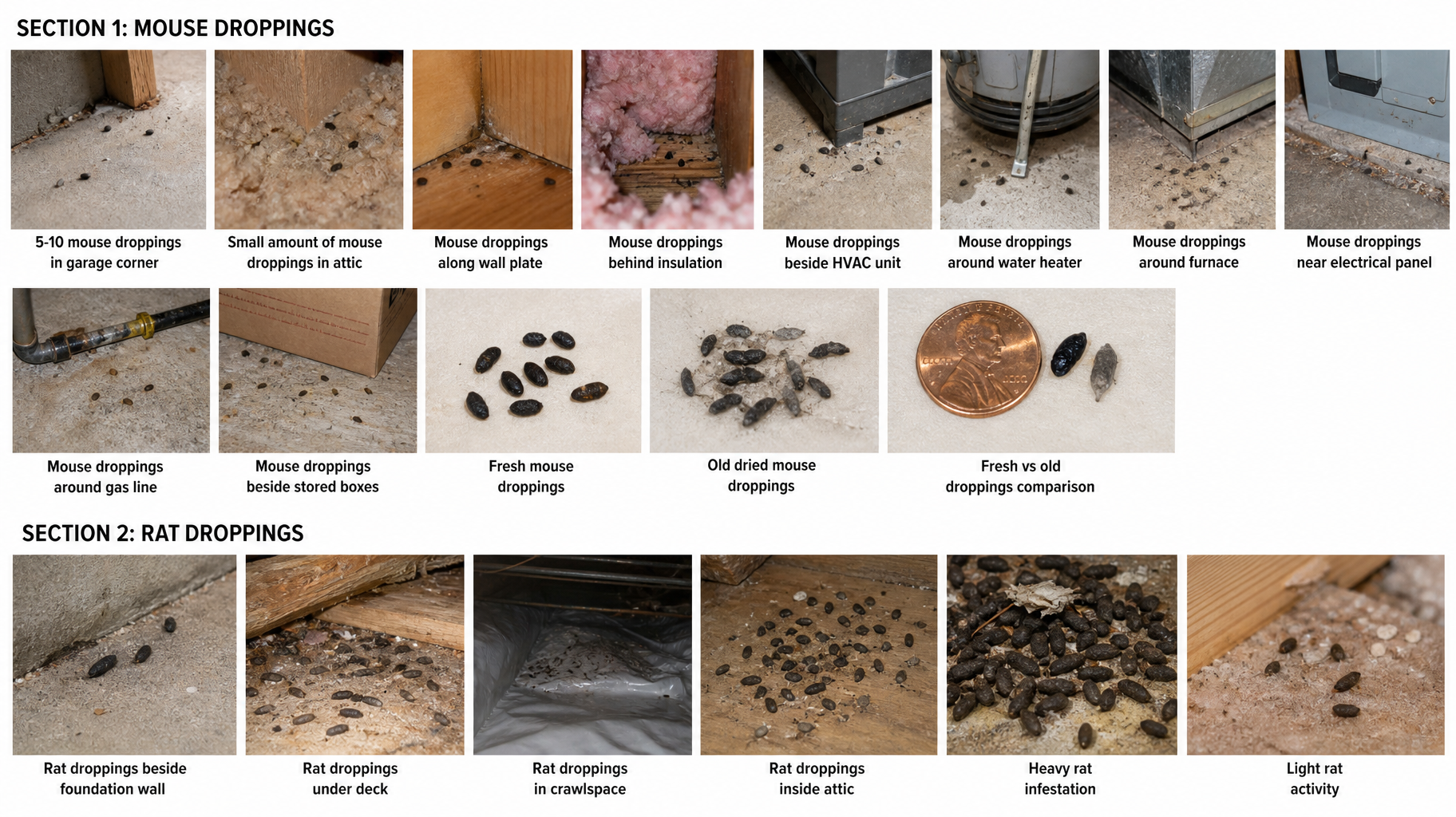
Mouse vs. rat droppings
- Mouse: small, pointed, like grains of rice
- Rat: larger, thicker, blunt-ended
- Put a coin next to them for scale
A single mouse leaves dozens of droppings a day, scattered wherever it travels — drawers, under sinks, along baseboards. Rats leave fewer but much larger droppings, often in groups along walls and near food.
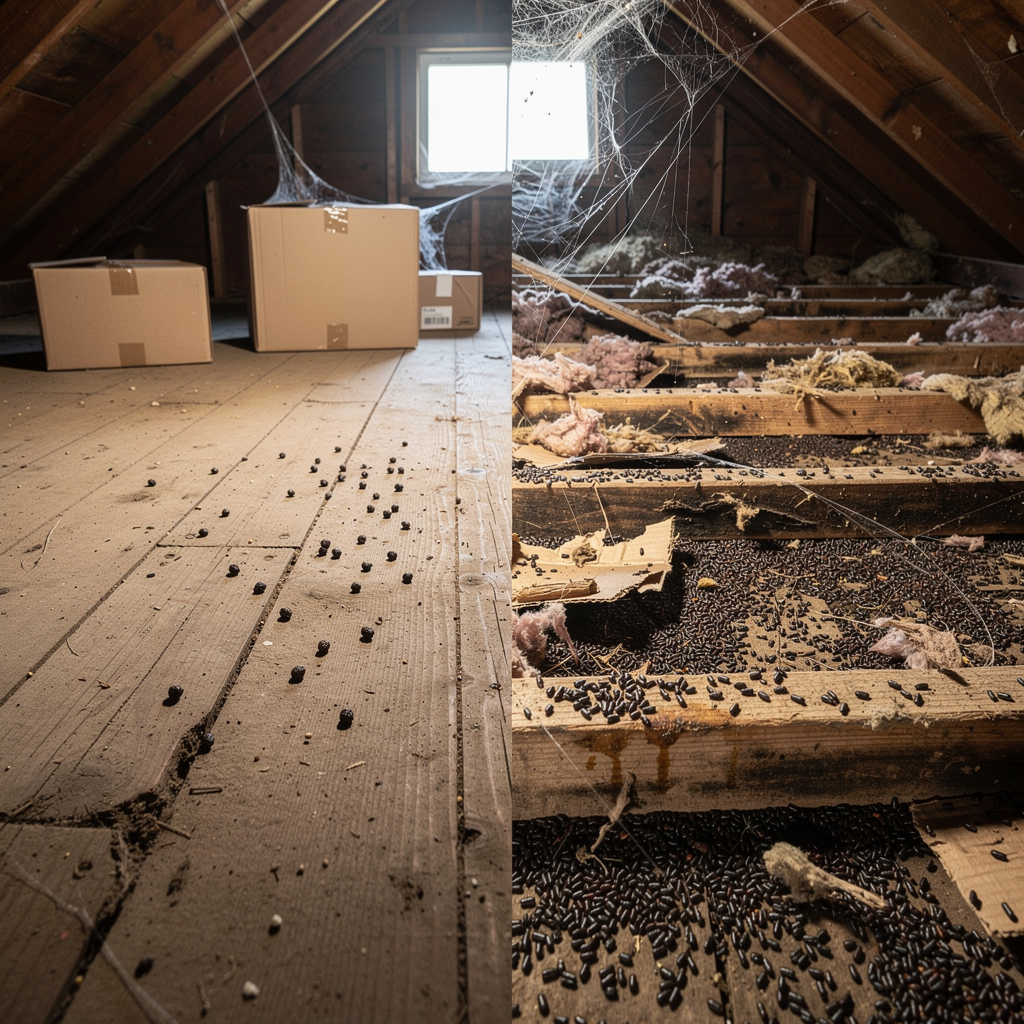
Light vs. heavy activity
- A few droppings: new or small problem
- Piles in several rooms: established
- Fresh droppings are dark and soft; old are gray and crumbly
How many droppings and how fresh they are tells you how long the rodents have been there. Clean up once, then check the same spots a day later — new droppings mean they're still active.

Where you found them
- Kitchen drawers and pantry: usually mice
- Basement floor, garage, by trash: often rats
- Attic insulation: mice, or another animal
Where droppings show up is a strong hint. Mice live close to food inside the house. Rats usually come in from outside, so their signs cluster low in the house and near doors, drains and the foundation.
Sounds, smells and other signs
If you haven't found droppings yet, these clues help:
- Noise: mice make light, quick scratching and skittering in walls and ceilings, mostly at night. Rats sound heavier — thumping, gnawing and dragging, often lower in the house or in the basement.
- Gnaw marks: mouse chewing leaves small, neat holes in food boxes and bags. Rat gnawing is rougher and larger, on wood, plastic bins, doors and even soft metal.
- Rub marks: rats leave greasy dark smudges along walls, pipes and beams they travel every night. Mice leave lighter marks that are hard to see.
- Burrows outside: holes about 2 to 4 inches wide along the foundation, under decks, sheds or slabs, or near trash cans point to rats. Mice rarely burrow in the yard. See rat burrows around the house.
- Smell: a strong, stale, ammonia-like odor in a closed space usually means many mice or rats over time.
- Nests: mice shred paper, fabric and insulation into small balls in drawers, behind appliances and in the attic.
Noises in the attic early in the morning, with heavier footsteps, may not be rodents at all — squirrels are active at dawn and dusk. Our attic noises guide helps tell them apart.
Is it a young rat or an adult mouse?
This is the mix-up we hear most. A young rat can be about the size of a big mouse, so size alone can fool you. Look at the proportions instead:
- Head and feet: young rats have a big head and oversized feet for their body. Mice have small, delicate heads and feet.
- Ears: a mouse's ears look large for its head. A young rat's ears are smaller and closer to the head.
- Tail: a young rat's tail already looks thick. A mouse's tail is thin, like a string.
- Where you see it: if you saw a young rat, there's almost always a family nearby.
Not sure? Snap a photo (even a blurry one) or photograph a dropping next to a coin and text it to 973-510-2585. We'll tell you what you're dealing with.
How mice and rats behave differently
Curious vs. cautious
Mice check out anything new, so traps often work in the first night or two. Rats are wary of new objects and can avoid a trap for days.
Short trips vs. long trips
Mice live and feed close to their nest. Rats travel much farther every night for food and water.
Water
Mice can get most of their water from food. Rats need a water source daily — leaks, drains, pet bowls, puddles.
Climbing vs. digging
Mice climb walls and wires and nest up high. Norway rats are diggers and swimmers that usually stay low, in burrows and basements.
Both breed fast. A few mice in the fall can become a real infestation by winter, and rats left alone spread their burrows across the yard.
Why it matters: mice and rats need different treatment
Using the wrong approach is the most common reason DIY rodent control fails:
| Mice | Rats | |
|---|---|---|
| Trap placement | Many traps, close together, along walls and near nests | Fewer, larger traps on rat runways, often pre-baited before setting |
| Trap size | Mouse snap traps | Rat-sized traps — mouse traps only injure a rat |
| Timing | Results often within days | Can take longer because rats avoid new things |
| Sealing | Gaps as small as a dime: pipes, wires, door corners | Foundation holes, drains, vents, gaps under doors and garage doors |
| Outside work | Less important | Very important: burrows, trash, food and water sources |
| Coming back | Usually through small gaps you missed | Usually through new or reopened burrows and openings |
Poison is a poor fix for either one inside a home: rodents can die in the walls and smell, and loose bait is a danger to kids and pets. Read rat poison vs. traps for the full picture.
Are mice or rats more dangerous? Health risks and safe cleanup
Both can carry germs and contaminate food and surfaces with their droppings and urine. Rats are larger, bite harder if cornered and do more structural damage; mice spread out through more of the house because they live inside. Either way, the damage isn't just to food — both chew wiring, which is a fire risk, and both ruin insulation.
Clean up droppings safely:
- Open windows and let the area air out first.
- Wear disposable gloves (and a mask in a closed space).
- Wet the droppings first with a disinfectant or a bleach-and-water mix and let it soak — never sweep or vacuum them dry, which puts dust in the air.
- Wipe up with paper towels, bag them, and wash your hands well.
Heavy contamination in an attic or crawlspace is a bigger job. We do HEPA cleanup and odor control, and attic insulation removal and replacement when rodents have ruined it.
Getting rid of mice or rats: when to call a pro
A single mouse that wandered into the garage can often be handled with a couple of well-placed snap traps and a sealed gap. Call a professional when:
- You're still catching or hearing them after two weeks of trapping.
- You see signs of rats — burrows, large droppings, heavy gnawing.
- Droppings are in several rooms or on more than one floor.
- You live in a two-family or apartment building and they're coming from another unit.
- There's a smell in the walls, or kids and pets make poison out of the question.
Silver Bullet Pest Control inspects inside and out, removes the rodents with traps placed where kids and pets can't reach, uses locked tamper-resistant stations outside where they make sense, and seals entry points with materials rodents can't chew. Mouse service includes 90 days of coverage with unlimited free service calls. We serve Bergen, Passaic, Essex and Hudson counties from Garfield, and quotes are free — call or text 973-510-2585. More on our mouse and rat extermination service and rodent proofing.
More rodent guides
Mice or Rats? Get a Free Quote
Tell us what you're finding and where — send a photo of the droppings next to a coin if you can. We'll tell you what it is and give you a free quote.
Why people call us
- Droppings and not sure what left them
- Scratching in the walls or ceiling at night
- Burrows by the foundation, deck or shed
- Traps aren't catching anything anymore
- Rodents coming from the unit next door
Request Service
🔒 Your info stays private · Hablamos español.
Mice vs. Rats: Common Questions
How can I tell if I have mice or rats?
The easiest way is the droppings: mouse droppings are small and pointed like grains of rice, while rat droppings are about the size of a raisin or bigger with blunt ends. Rats also leave burrows outside and heavier gnaw marks. Text a photo of the droppings next to a coin to 973-510-2585 and we'll tell you.
Is it worse to have rats or mice?
Rats are usually the bigger problem: they're larger, do more damage, are harder to trap and often mean a burrow system outside. But mice spread through more of the house and breed quickly, so a mouse problem left alone gets bad fast too. Both should be dealt with early.
Can mice and rats live in the same house?
They can, but it's not common to have both in the same area for long, because rats will prey on mice. Finding both kinds of droppings usually means rats in the basement or garage and mice higher up in walls and cabinets.
Do mice turn into rats?
No. Mice and rats are different species. A young rat can be mistaken for a mouse, but it has a bigger head, larger feet and a thicker tail, and it will keep growing to rat size.
What size hole can a mouse or rat fit through?
A mouse can squeeze through a gap about the size of a dime, and a rat through a gap about the size of a quarter. That's why sealing small gaps around pipes, wires, vents and doors matters as much as trapping.
Why do I hear them at night?
Both mice and rats are most active after dark. Light, fast scratching in walls or ceilings usually means mice; heavier thumping and gnawing, especially low in the house, points to rats. Sounds in the attic at dawn and dusk may be squirrels instead.
Are mouse traps strong enough for rats?
No. A mouse snap trap is too small and often only injures a rat. Rats need rat-sized traps placed along the paths they use, and because they avoid new objects, the traps sometimes need to sit unset with bait for a few days first.
Do mice and rats carry diseases?
Yes, both can carry germs and contaminate food and surfaces with droppings and urine. Never sweep or vacuum droppings dry — wet them first with a disinfectant, wear gloves, and wipe them up. For heavy contamination, we offer HEPA cleanup and odor control.
How long does it take to get rid of mice vs. rats?
Mice often drop off within a week or two once traps are set and gaps are sealed. Rats can take longer because they're cautious and may have burrows outside. Either way, sealing the entry points is what keeps them from coming back.
Does your rodent service come with a warranty?
Mouse service includes 90 days of coverage with unlimited free service calls during that time. For rats, we'll explain the plan and follow-up visits when we give you your free quote.
¿Cómo sé si tengo ratones o ratas?
Mire los excrementos: los de ratón son pequeños y puntiagudos como un grano de arroz; los de rata son más grandes, como una pasa. Mándenos una foto al 973-510-2585 — hablamos español.
Mouse & rat control in North Jersey
From our base in Garfield we serve Bergen, Passaic, Essex and Hudson counties.
Our service area
Bergen County
973-510-2585- Allendale
- Bergenfield
- Bogota
- Carlstadt
- Cliffside Park
- Closter
- Cresskill
- Demarest
- Dumont
- East Rutherford
- Edgewater
- Elmwood Park
- Emerson
- Englewood
- Englewood Cliffs
- Fair Lawn
- Fairview
- Fort Lee
- Franklin Lakes
- Garfield
- Glen Rock
- Hackensack
- Harrington Park
- Hasbrouck Heights
- Haworth
- Hillsdale
- Ho-Ho-Kus
- Leonia
- Little Ferry
- Lodi
- Lyndhurst
- Mahwah
- Maywood
- Midland Park
- Montvale
- Moonachie
- New Milford
- North Arlington
- Northvale
- Norwood
- Oakland
- Old Tappan
- Oradell
- Palisades Park
- Paramus
- Park Ridge
- Ramsey
- Ridgefield
- Ridgefield Park
- Ridgewood
- River Edge
- River Vale
- Rochelle Park
- Rutherford
- Saddle Brook
- Saddle River
- South Hackensack
- Teaneck
- Tenafly
- Teterboro
- Upper Saddle River
- Waldwick
- Wallington
- Washington Township
- Westwood
- Woodcliff Lake
- Wood-Ridge
- Wyckoff
Passaic County
973-510-2585- Bloomingdale
- Clifton
- Haledon
- Hawthorne
- Little Falls
- North Haledon
- Passaic
- Paterson
- Pompton Lakes
- Prospect Park
- Ringwood
- Totowa
- Wanaque
- Wayne
- West Milford
- Woodland Park
Essex County
973-510-2585- Belleville
- Bloomfield
- Caldwell
- Cedar Grove
- East Orange
- Essex Fells
- Fairfield
- Glen Ridge
- Irvington
- Livingston
- Maplewood
- Millburn
- Montclair
- Newark
- North Caldwell
- Nutley
- Orange
- Roseland
- Short Hills
- South Orange
- Verona
- West Caldwell
- West Orange
Hudson County
973-510-2585Union County
973-510-2585- Berkeley Heights
- Clark
- Cranford
- Elizabeth
- Fanwood
- Garwood
- Hillside
- Kenilworth
- Linden
- Mountainside
- New Providence
- Plainfield
- Rahway
- Roselle
- Roselle Park
- Scotch Plains
- Springfield
- Summit
- Union
- Westfield
Morris County
973-510-2585- Boonton
- Butler
- Cedar Knolls
- Chatham
- Denville
- Dover
- East Hanover
- Florham Park
- Hanover
- Kinnelon
- Lincoln Park
- Madison
- Mendham
- Montville
- Morris Plains
- Morristown
- Mountain Lakes
- Parsippany
- Pequannock
- Randolph
- Riverdale
- Rockaway
- Roxbury
- Whippany
Updated November 2026 by the Silver Bullet Pest Control team, Garfield, NJ • NJ License 90568B